Quiz Entry - updated: 2026.07.30
What was the data speed progression from 1G to 5G?
Each generation delivered roughly a 10-100x speed increase over its predecessor.
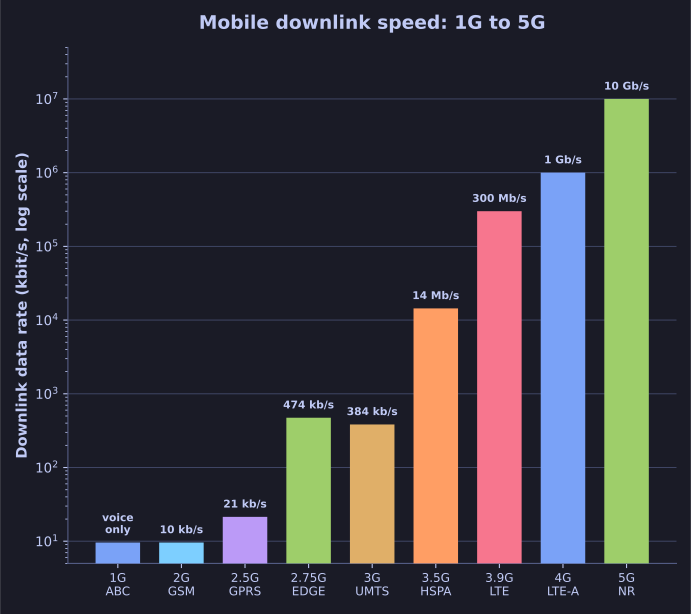
* Downlink speed climbs from kbit/s to Gbit/s (log scale). *
| Generation | Standard | Downlink Speed | Uplink Speed | Key Feature |
|---|---|---|---|---|
| 1G | ABC (analog) | Voice only | Voice only | First mobile calls |
| 2G | GSM | 9.6 kbit/s | 9.6 kbit/s | Digital voice, SMS |
| 2.5G | GPRS | ~56–114 kbit/s | ~56–114 kbit/s | Packet data, mobile internet |
| 2.75G | EDGE | ~473.6 kbit/s | ~473.6 kbit/s | Better modulation |
| 3G | UMTS | 384 kbit/s | 128 kbit/s | Video calls, streaming |
| 3.5G | HSPA | 14.4 Mbit/s | 5.76 Mbit/s | Usable mobile broadband |
| 3.9G | LTE | 300 Mbit/s | 75 Mbit/s | All-IP, OFDMA |
| 4G | LTE-A | 1 Gbit/s | 500 Mbit/s | True broadband |
| 5G | NR | 10 Gbit/s | 2 Gbit/s | mmWave, sub-1ms latency |
The pattern: Even generations (2G, 4G) tend to be revolutionary, introducing completely new architectures. Odd generations (3G, 5G) push performance boundaries. The ".5G" steps squeeze maximum value from existing infrastructure before the next leap.
Memory anchor: The approximate order of magnitude is what matters most: 2G = kbit/s, 3G = Mbit/s, 4G = hundreds of Mbit/s, 5G = Gbit/s.
Go deeper:
 History of Mobile Communications: 1G–5G (Electronics Notes) — the same generation-by-generation timeline in prose, with launch dates and the standard behind each step.