Quiz Entry - updated: 2026.07.30
What's the tradeoff between data rate and range in wireless technologies?
There is a fundamental tradeoff: higher data rates generally come with shorter range. Technologies optimize for one or the other.
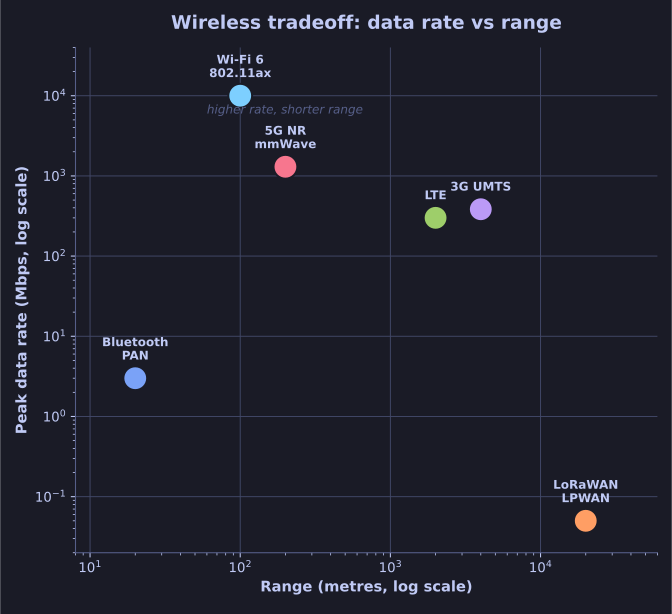
* Data rate vs range: higher speed usually means shorter reach. *
The landscape by range category:
| Range | Category | Technologies | Data Rate |
|---|---|---|---|
| Indoor (10-30m) | PAN/BAN | 802.15.4, Bluetooth | 0.056-4 Mbps |
| Outdoor (50-200m) | WLAN | 802.11b/a/g/n/ac/ax | 5-10,000 Mbps |
| Mid-range (200m-4km) | Cellular | 2G GSM, 3G UMTS/HSPA, LTE, 5G NR | 0.056-1,300+ Mbps |
| Long-range (5-20km) | LPWAN/Cellular | LoRaWAN, 2G, 3G | 0.056-384 Mbps |
Key observations:
- Wi-Fi 6 (802.11ax) reaches up to 10 Gbps but only indoors. It rivals 5G in raw speed but can't match its range.
- 5G NR spans a huge range on both axes because it uses multiple frequency bands. mmWave gives extreme speed at short range, sub-6 GHz gives moderate speed at longer range.
- LoRaWAN sits in the opposite corner: very long range (20+ km) but tiny data rates. Perfect for IoT sensors that send a few bytes per hour.
- LTE occupies the "sweet spot" for most mobile use: decent speed at medium range.
The physics behind it: Higher frequencies can carry more data (wider bandwidth) but are absorbed more easily by air, walls, and rain. Lower frequencies travel further but carry less data. This is an inescapable law of physics that shapes all wireless design.
Go deeper:
 LPWAN (Wikipedia) — the opposite corner of the chart: how LoRaWAN and friends trade nearly all throughput for 20+ km range and years of battery life.