When a subscriber roams, what roles do the home network, the visited network, and the SIM card play?
The home network (where your contract lives) stores your identity and service data in its HSS; the visited network is any other network that serves you thanks to roaming agreements; the SIM carries the global identification information that links you to your home network.
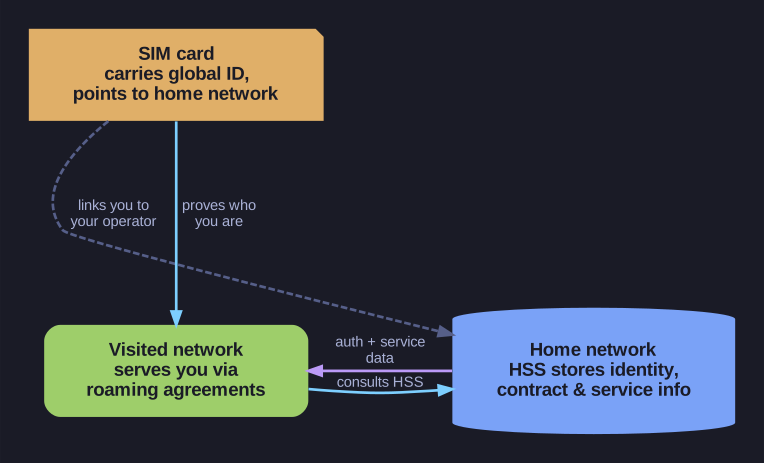
* The roaming triangle: the SIM proves identity, the visited network serves you, the home HSS stays the source of truth. *
The three actors:
| Actor | Role |
|---|---|
| Home network | Your contractual operator (e.g., Swisscom or Salt — depending on your contract). Its HSS stores identification, contract, and service information |
| Visited network | Any network other than the home network. Its provider holds contracts and service agreements with other networks to allow visiting subscribers access |
| SIM card | Carries the global identification information that tells any network who you are and where your home network is |
Why this triangle matters: roaming only works because (a) your SIM proves your identity anywhere, (b) the visited network has a business agreement with your home operator, and (c) your home HSS remains the single source of truth that the visited network consults.
Mobility refresher: the challenge scales from no mobility (stationary user, one access point) through disconnecting and reconnecting while moving, up to high mobility (connections maintained seamlessly across networks — the mobile phone case). More mobility = more network functionality required, but more comfort for the user.
Go deeper:
 Roaming (Wikipedia) — home vs visited network and the inter-operator agreements + AAA billing that let your SIM work abroad.