When choosing how to represent a requirement, what are the four "degrees of freedom" you can dial?
You can choose the instrument (natural language → structured models → interaction models → formal model), the structure, the precision, and the depth (deepness) of the representation.
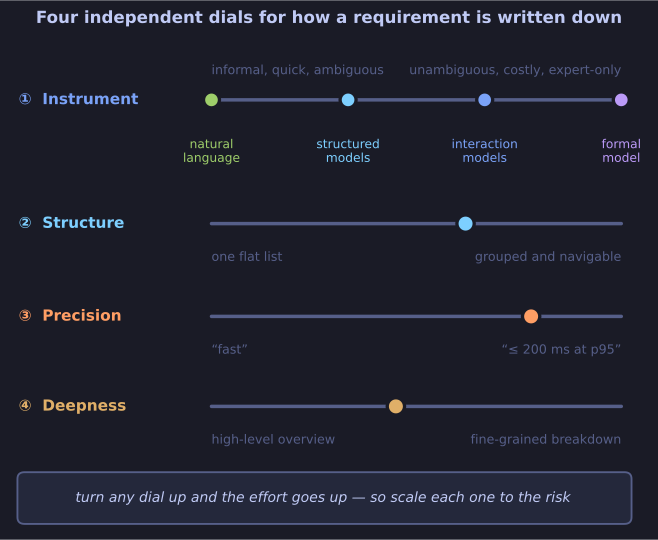
* Four dials you set independently; turning any of them up costs more effort, so each is scaled to the risk. *
A requirement is not written one fixed way — you have four independent dials, and you tune each to the situation (how risky, how complex, how formal the project is):
- Choice of the instrument — how you express it, on a spectrum from informal to formal:
- Natural language (plain prose) — quick and accessible to everyone, but ambiguous.
- Structured models — templates and structured text that constrain the wording.
- Interaction models — use-case and sequence diagrams that pin down who does what, in what order.
- Formal model (mathematical notation) — unambiguous and machine-verifiable, but expensive and requiring expertise on both the writing and the reading side.
- Structure — how you organise and group the requirements so the set can be navigated.
- Precision — how exact and quantified the statement is ("fast" vs. "≤ 200 ms at the 95th percentile").
- Deepness (depth) — how far you drill in: a high-level overview versus a fine-grained breakdown.
These four are about how the content is captured. The content itself — the presentation — covers functionality (function, data and behaviour) and attributes (performance, quality, surrounding conditions).
The dials are independent, and that is the useful part: you can write a precise requirement in natural language ("the confirmation appears within 2 s"), or a vague one in a formal notation. Turning up formality does not automatically buy precision, and turning up precision on something nobody has decided yet just documents a guess in more digits.
Tip: More formality, precision and depth all cost more effort, so scale them to the risk — a throwaway prototype gets natural language; a safety-critical or contractual requirement earns a precise, structured, possibly formal representation.
Go deeper:
 Formal specification (Wikipedia) — what the far end of the instrument dial actually looks like.
- Formal methods (Wikipedia) — where paying that cost is justified, and where it is not.