When does a compiler choose a jump table versus an if-else chain (or decision tree) for a switch?
Jump table when the case values are dense (few gaps); an if-else chain for just a few cases; a balanced decision tree when there are many but sparse values.
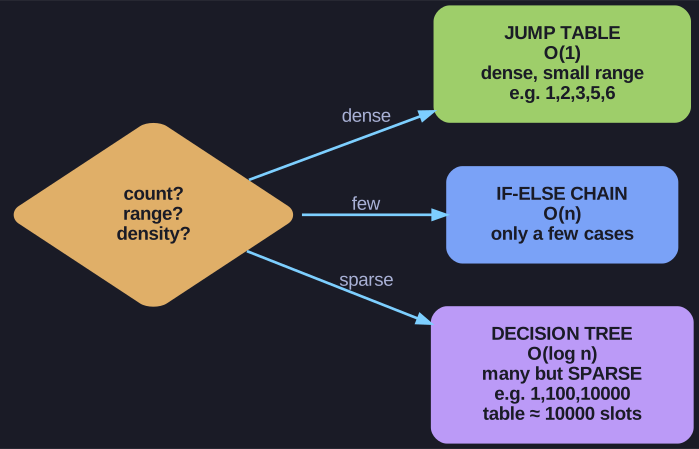
* Density decides: jump table (dense), if-else chain (few cases), or decision tree (many sparse). *
The compiler weighs lookup speed against memory wasted on empty table slots:
| Implementation | Used when | Lookup cost |
|---|---|---|
| Jump table | Cases are dense over a small range | O(1) |
| If-else chain | Only a handful of cases | O(n) |
| Decision tree | Many cases, but spread far apart | O(log n) |
It decides based on the number of cases, the range of their values, and the resulting density (what fraction of the range is actually used).
case 1,2,3,5,6→ 7-entry table, mostly full → jump table (fast, little waste).case 1, 100, 10000→ a table would need ~10000 entries for 3 cases → if-else / decision tree instead.
Why you care: the compiler, not you, picks the low-level form — and the same switch source can compile to entirely different machine code depending on how the case labels happen to cluster.
Go deeper:
 Branch table / jump table (Wikipedia) — jump-table dispatch.
- Switch statement (Wikipedia) — the switch implementation strategies a compiler weighs.