When you locate a device via its serving antenna, what does the result actually tell you about where the device is?
The result is an antenna ID — meaning the device is somewhere in the area covered by that antenna. Theoretical coverage maps (a mathematical model) can be requested from the Dienst ÜPF; they are generally fairly good, but the search area should be chosen generously.
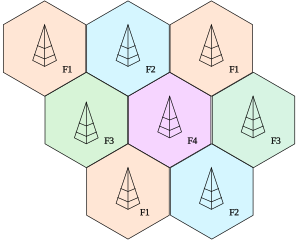
* Each hexagonal cell is one antenna's coverage area. — Andrew pmk, CC BY-SA 2.5, via Wikimedia Commons. *
What you actually get back is an antenna ID, and the inference it licenses is modest:
The device is located in the area covered by that antenna.
To refine that area, investigators can request coverage maps with a theoretical coverage footprint from the Dienst ÜPF. These maps come from a mathematical model and are generally relatively good — but the search area should still be chosen rather generously, because the model is an estimate, not a precise boundary.
You can also narrow the direction: a cell tower is usually split into sectors (typically 3, each covered by an antenna pointed at a different azimuth), so knowing which sector served the device tells you roughly which way it lay from the tower. Operators can even model a per-sector coverage footprint — effectively a coverage heatmap that bounds the likely area. But this still yields an area, not a GPS-precise point.
The reason for that generosity is physical: real radio coverage is irregular, shaped by terrain, buildings, weather, and cell breathing, so the true serving area can extend beyond the modelled footprint. Drawing the search area too tightly risks excluding the device's actual location — a false negative that could be fatal in an emergency search. It is safer to search a larger area than to wrongly rule out the right one. Cell-based location is therefore an area, not a point.
Tip: The honest output is "somewhere in this cell's footprint" — and that footprint should be drawn with margin.
Go deeper:
 Mobile phone tracking (Wikipedia) — Cell-ID positioning: the device is somewhere within the serving cell's coverage footprint, an area not a point.