Where are the signals combined during soft vs. softer handover, and what is the uplink/downlink trade-off?
In soft handover (two different NodeBs) the uplink signals are combined in the RNC; in softer handover (two sectors of one NodeB) they are combined in the NodeB itself. The uplink gains performance for free, but every extra downlink link adds interference for other users.
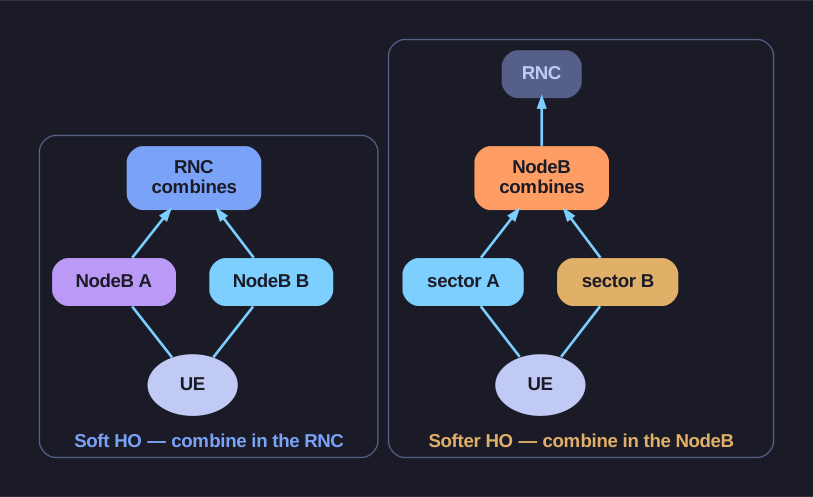
* Where the uplink signals combine: in the RNC for soft handover, in the NodeB for softer. *
Signal combination — the mobile maintains active radio links to more than one NodeB, and the network combines them:
| Handover type | Mobile connected to | Uplink signals combined in |
|---|---|---|
| Soft | (at least) two different NodeBs | the RNC |
| Softer | two sectors within one NodeB | the NodeB (no need to go up to the RNC) |
The asymmetric cost:
- Uplink: the mobile transmits no additional signal — both cells simply listen to the same transmission. Combining their receptions generally increases performance at no radio cost
- Downlink: each additional link means an additional transmission — which causes interference for other users in those cells
The trade-off: soft handover buys connection robustness and uplink gain at the price of downlink interference. This is why the Active Set is kept small and why hysteresis prunes it promptly — every member costs downlink capacity.
Tip: Remember "uplink free, downlink costly": one phone shouting once vs. several towers each transmitting a copy.
Go deeper:
 Rake receiver (Wikipedia) — the multi-finger correlator that combines several signal copies, the mechanism behind soft/softer uplink combining.
- Soft handover (Wikipedia) — why simultaneous multi-cell links cost downlink capacity even though the uplink combine is free.