Which connection type dominated the Swiss cnlab.ch snapshot used in the 2026 material?
In that two-month snapshot, NR/NSA connections dominated, with 4G-LTE as the next largest segment.
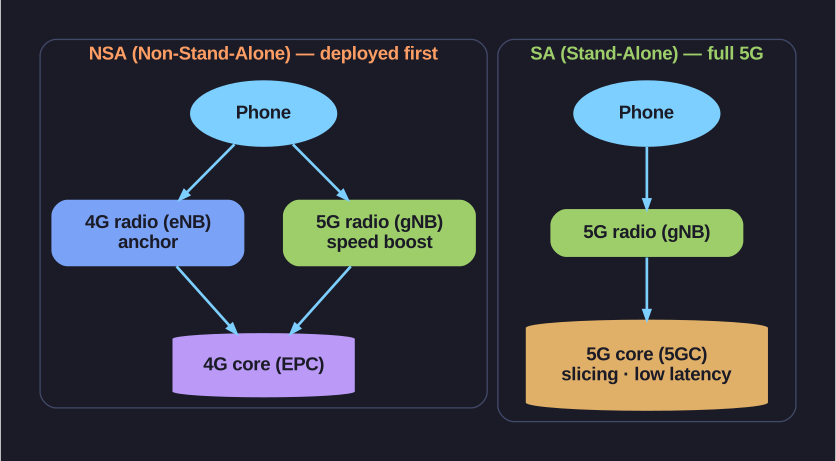
* NSA keeps the 4G core (fast to deploy); SA's new 5G core is what unlocks slicing and ultra-low latency. *
Distribution (cnlab.ch, measured over a two-month window in Switzerland):
Reading the slices from largest to smallest:
- -NR/NSA: the single largest slice (roughly 40%). The missing generation prefix likely means the device reported an NR/NSA connection but didn't specify a clean generation label.
- 4G-LTE: the second largest slice.
- 5G-NR/NSA: the third largest slice, where the connection was explicitly identified as 5G riding NSA.
So although plain 4G-LTE is still the single biggest labelled-by-generation segment, the two NR/NSA slices combined outweigh it, which is why NR/NSA overall has overtaken pure LTE.
Other, smaller segments:
- 4G-LTE/CA (Carrier Aggregation, bonding multiple LTE bands).
- Unknown-Unknown: a noticeable share of unclassified connections.
- 3G-HSPA+, 3G-HSDPA, 3G-WCDMA: still present but small.
- 5G-NR (Stand-Alone): a small but growing slice.
Key takeaway: NR/NSA connections have clearly overtaken 4G-LTE. But nearly all of these are NSA (Non-Stand-Alone), meaning they still rely on the 4G core network. True stand-alone 5G remains only a tiny fraction.
Why operators deployed NSA before SA: Building a full 5G Stand-Alone core network is expensive and complex. NSA lets operators offer "5G speeds" by just upgrading the radio access while keeping the existing 4G backbone. It's faster and cheaper to roll out, which is why early 5G was overwhelmingly NSA, but it doesn't unlock all 5G features like network slicing or ultra-low latency.
Go deeper:
 5G (Wikipedia) — the generation overview, including the NSA-vs-SA deployment paths and the features each enables.
- 5G NR (Wikipedia) — the New Radio air interface itself, the part that rides on either a 4G (NSA) or 5G (SA) core.