Quiz Entry - updated: 2026.07.30
Why are IEEE 802 standards described as "specific to the type of network"?
Because the 802 family defines a separate standard for each network type — Ethernet, WLAN, WPAN, and so on — rather than one universal data link standard.
The IEEE 802 LAN/MAN standards govern the data link layer, but they are not one-size-fits-all:
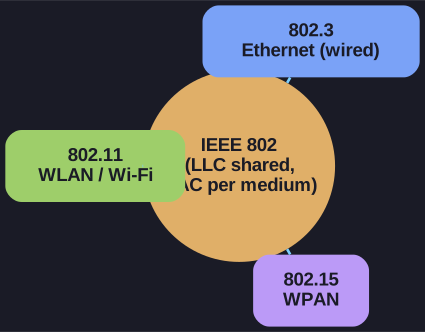
* A shared LLC rides on a medium-specific MAC, so each network type gets its own 802 standard. *
- Each standard is specific to the type of network it serves — for example Ethernet, WLAN (wireless LAN), and WPAN (wireless personal area network).
- These standards split the data link layer into the LLC and MAC sublayers, letting the upper LLC stay common while the lower MAC is tailored to each medium.
Why it matters: This is why a wired Ethernet NIC and a Wi-Fi adapter, though both Layer 2 devices, follow different 802 standards and different media access methods (CSMA/CD-era Ethernet vs CSMA/CA Wi-Fi).
Go deeper:
 IEEE 802 (Wikipedia) — a separate standard per network type (802.3 Ethernet, 802.11 WLAN, 802.15 WPAN) and the split of the data link layer into LLC + MAC sublayers.
- IEEE 802.2 — LLC (Wikipedia) — the LLC sublayer: one upper layer riding on medium-specific MAC sublayers, which is precisely why per-network standards exist.