Quiz Entry - updated: 2026.07.30
Why can floating-point arithmetic give mathematically incorrect results?
Floating-point keeps only a fixed number of significant digits, so adding a tiny value to a huge one can lose it entirely — which makes operations non-associative.
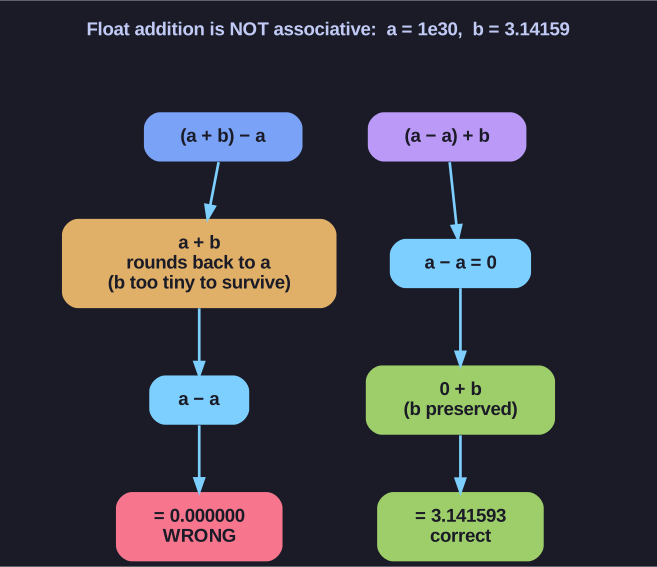
* Because a tiny addend is lost when added to a huge value, (a+b)-a collapses to zero while (a-a)+b preserves it, showing floating-point addition is not associative. *
float a = 1e30;
float b = 3.14159265358979;

// These SHOULD be equal:
printf("1. %.1f + %.6f - %.1f = %.6f\n", a, b, a, a+b-a);
printf("2. %.1f - %.1f + %.6f = %.6f\n", a, a, b, a-a+b);
Output:
1. 10000...0.0 + 3.141593 - 10000...0.0 = 0.000000   <- WRONG!
2. 10000...0.0 - 10000...0.0 + 3.141593 = 3.141593  <- Correct
Why (a + b - a) != b:
- Adding small
bto hugealosesb(not enough precision) a + beffectively equalsa- Then
a - a = 0
Lesson: Order of operations matters with floating-point! Floating-point is NOT associative.
Tip: When mixing large and small floats, operate on similar magnitudes first. Sort values by magnitude or use compensated summation (Kahan algorithm) for precision.
Go deeper:
 What Every Computer Scientist Should Know About Floating-Point (Goldberg) — the canonical paper on rounding error, cancellation, and why FP diverges from exact math.
- Floating-point arithmetic (Wikipedia) — IEEE 754, non-associativity of addition, and precision loss with worked examples.