Quiz Entry - updated: 2026.10.15
Why do digital signatures require stronger hash functions than HMAC or session key generation?
Because signatures must remain valid for 15-20 years, while MACs and session keys only need to last for the duration of a single communication.
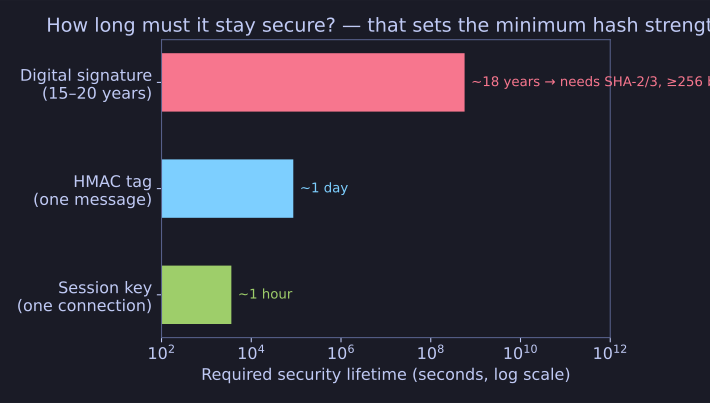
* A signature must survive decades of future attacks; a MAC tag or session key is relevant for one message or connection. *
The key difference is time horizon:
| Use Case | Required Lifetime | Hash Strength Needed |
|---|---|---|
| Digital signature | 15-20 years | Must resist future attacks — use strongest available |
| HMAC for integrity | Duration of message processing | Short-lived — adequate security now is sufficient |
| Session key derivation | Duration of one connection | Very short-lived — even key renegotiation during session |
This is why:
- Signatures must use SHA-2 or SHA-3 with at least 256 bits
- HMAC can still use SHA-1 (per BSI) because collision resistance isn't the primary security property for MAC
- Even MD5 is still used in some PRF constructions (like older TLS versions) because the exposure window is minutes, not decades
Tip: When choosing a hash function, always ask: "How long must this remain secure?" — that determines your minimum hash size.