Why does a phone register twice — once for telephony and once for data — and with which network elements?
Registration is performed separately for phone/SMS service (toward the MSC/VLR) and for data service (toward the SGSN); the procedures are nearly identical, with the data variants prefixed "GPRS …".
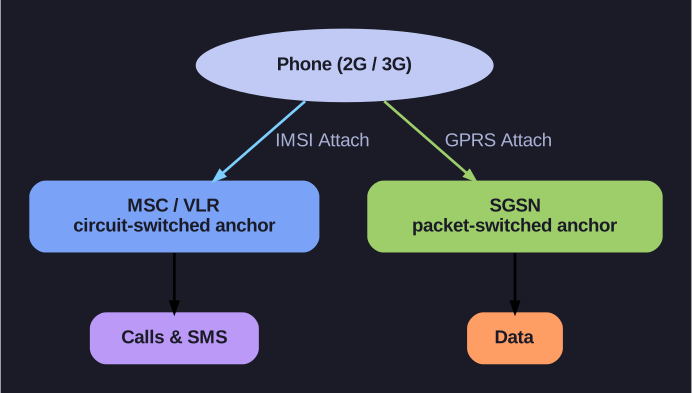
* Two parallel registrations: circuit-switched and packet-switched. *
The two registrations:
| Service | Anchor node | Entitles the phone to |
|---|---|---|
| Telephone/SMS | MSC/VLR (anchor for telephony and SMS) | making calls, sending SMS |
| Data | SGSN (anchor for data) | transmitting data |
The naming pattern: the flow and messages are nearly identical in both cases — for data connections the messages simply carry the prefix "GPRS …". So the data-side counterpart of the IMSI Attach registration is the GPRS Attach.
Why two separate anchors? This mirrors the 2.5G/3G architecture split: the circuit-switched domain (MSC) and the packet-switched domain (SGSN) are parallel worlds that each need to know and authenticate the subscriber.
Does this still apply in 4G/5G? No — the double registration is a 2G/3G thing. LTE's core (EPC) is all-IP with no circuit-switched domain, so a phone performs a single Attach to the MME (in 5G: a single Registration to the AMF). Voice is no longer a separate registration: it rides over the data bearer as VoLTE/VoNR (voice over IMS). Older phones still fall back to 2G/3G for calls via CSFB (Circuit-Switched Fallback), which is exactly why the legacy dual registration lingered.
Practical consequence: a phone can be reachable for calls but not attached for data (or vice versa) — the two states are independent. That's also why old phones showed separate indicators for "network" and "GPRS".
Go deeper:
 GPRS core network (Wikipedia) — the packet-switched half of this split: how the SGSN handles the data-domain attach and mobility that parallels the MSC/VLR's circuit-switched registration.