Quiz Entry - updated: 2026.07.30
Why is "schoolbook" RSA deterministic, and why is this a security problem?
In textbook RSA, the same plaintext always produces the same ciphertext — this allows table-lookup attacks and leaks statistical patterns. OAEP padding solves this.
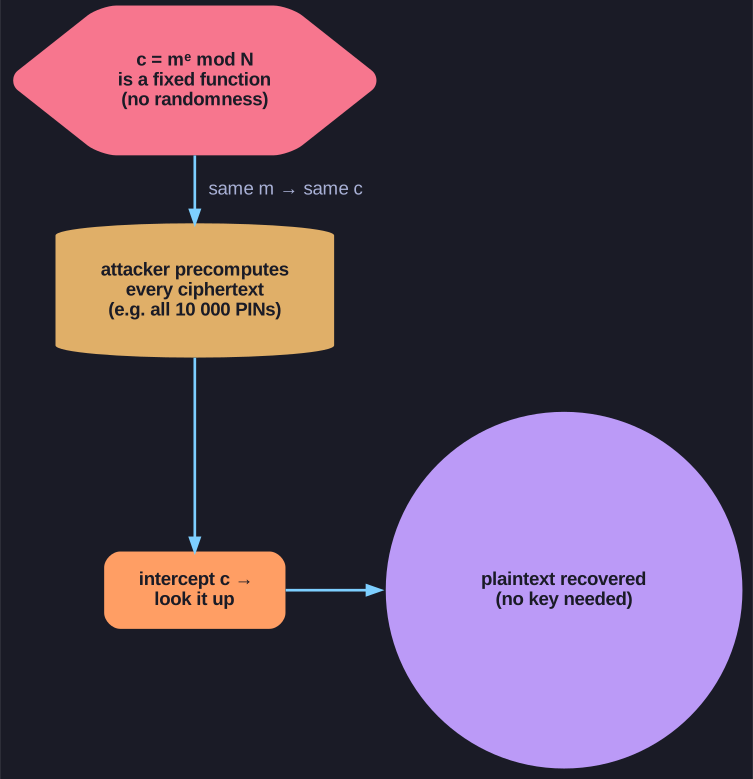
* Because the mapping is fixed, an attacker with a small message space can precompute every ciphertext and simply look up the intercept — no key needed. *
The problem: $c \equiv m^e \mod N$ is a deterministic function. Given the same key and message, you always get the same ciphertext.
Consequences:
- Table lookup attack: For small message spaces (like 4-digit PINs), an attacker can precompute all 10,000 possible ciphertexts and look up any intercepted one
- Statistical patterns: If certain plaintexts are more common, this frequency is visible in the ciphertext
- Known-plaintext matching: If you suspect a message was sent, encrypt it yourself with the public key and compare
Special "ugly" cases:
- $m = 0$ → $c = 0^e = 0$
- $m = 1$ → $c = 1^e = 1$
- $m = -1 = N-1$ → $c = (N-1)^e \mod N = N - 1$
The solution: OAEP (Optimal Asymmetric Encryption Padding)
- Add random padding to the plaintext before encrypting
- Specified in PKCS#1 v2.1
- Makes RSA probabilistic — same plaintext produces different ciphertext each time
- Destroys the homomorphic property and the deterministic mapping
Contrast: ElGamal and ECC are inherently probabilistic — ciphertexts change every time even for the same plaintext.
Go deeper:
 RSA — attacks on "textbook" RSA (Wikipedia) — why deterministic RSA is never used raw.
- Optimal asymmetric encryption padding (Wikipedia) — the randomised padding that fixes it.