Why is the privacy vs societal benefit trade-off not necessarily zero-sum?
Naively, more data → more insight → less privacy. But Privacy-Enhancing Technologies (PETs) bend the trade-off curve outward — you can get most of the analytical benefit while preserving most of the privacy.
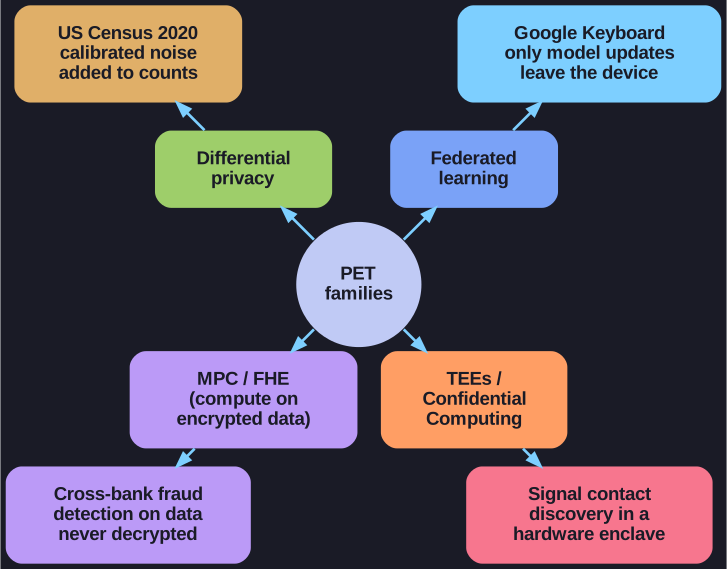
* Four PET families, each already in production, turn privacy-vs-benefit into a design choice rather than a zero-sum fight. *
The classic zero-sum curve (no PETs):
- Hospitals could improve treatments by sharing patient records → but doing so violates privacy.
- Tech companies could improve recommendations by analysing individual behavior → but doing so means surveillance.
With PETs, the trade-off shifts:
- Federated learning — model is trained across many devices; only model updates leave the device, never raw data. (Used by Google Keyboard, Apple QuickType.)
- Differential privacy — add calibrated noise to query results so individual contributions are statistically hidden but aggregate trends survive. (US Census 2020, Apple emoji stats.)
- MPC / FHE — compute on encrypted data; outputs are decryptable, inputs never were. (Genomic studies, fraud detection across banks.)
- TEEs / Confidential Computing — run sensitive computation in a hardware-enforced enclave so the cloud provider sees encrypted bytes only. (Signal contact discovery, AWS Nitro Enclaves.)
Concrete shift:
- Old curve: without PETs, the Pareto frontier between Privacy and Nutzen (utility) is steep — small privacy gains cost huge utility.
- New curve: with PETs, the frontier is shifted outward — you can get high utility and high privacy simultaneously.
Why this matters politically:
- "Privacy vs. innovation" is often framed as a zero-sum debate (regulators vs. companies).
- PETs offer a third path: regulation that mandates privacy-preserving techniques rather than banning data analysis outright.
- The EU's GDPR explicitly recognises this — "data minimisation" and "privacy by design" are foundational principles, satisfied largely through PETs.
Tip: When you see articles about "privacy-preserving AI", they're nearly always about applying one of the four PET families above. The math is real and improving fast. Watch the Open MPC Alliance, IEEE Privacy Engineering, and Real World Crypto conferences for the state of the art.
Go deeper:
 Differential privacy (Wikipedia) — a PET that yields aggregate utility with bounded individual leakage.