Why must VLSM allocation always start with the largest subnet, and what address does each new subnet begin at?
Start with the largest host requirement so the big block aligns cleanly; each subsequent subnet begins at the address immediately after the previous subnet's broadcast.
VLSM (Variable Length Subnet Masking) lets each subnet use a mask sized to its own host count, but that freedom only works if the blocks line up without overlapping. The catch is that every subnet must begin on a network address that is a multiple of its block size — a /25 (block 128) can only start at .0 or .128, a /26 (block 64) only at .0/.64/.128/.192, and so on. If you placed a small subnet first, you would split the address space at an odd boundary and a later large subnet might have no correctly aligned slot left to land on. Allocating largest-first guarantees the big, picky blocks get their aligned positions before the smaller, more flexible ones fill in the gaps. Each new subnet then simply starts at the address one past the previous subnet's broadcast, packing them contiguously with no waste.
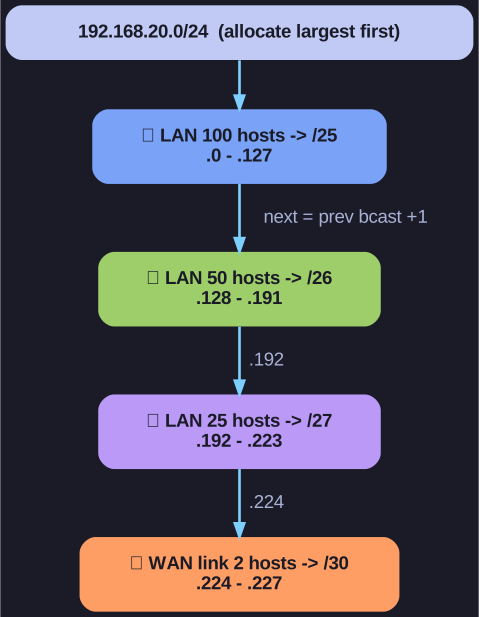
* Largest block first; each next subnet starts one past the previous broadcast. *
The rule: when using VLSM, satisfy the host requirements of the largest subnet first, then continue down to the smallest.
Worked fragment (from 192.168.20.0/24):
- LAN needing 100 hosts → /25 → 192.168.20.0 – .127 (broadcast .127)
- Next subnet starts at .128 (one past the previous broadcast)
- LAN needing 50 hosts → /26 → 192.168.20.128 – .191
- Next starts at .192 → /27 for 25 hosts → .192 – .223
- Point-to-point links → /30s starting at .224 (.224–.227, .228–.231, …)
Why largest first: if you placed small subnets first, a later large subnet might not have a correctly aligned block of contiguous addresses to land on (a /26 must start on a multiple of 64, a /25 on a multiple of 128, etc.). Largest-first guarantees alignment and avoids overlap or wasted gaps.
Go deeper:
 FLSM and VLSM, worked example (PracticalNetworking) — a multi-segment VLSM allocation done largest-first.
 Visual Subnet Calculator (davidc.net) — carve unequal blocks and see alignment enforced visually.