Question
What features make an environment like an operating theatre or a military operation a "special" setting for decision-making?
Answer
Steep hierarchy and command authority, an information gap between leader and led, real time-and-decision pressure, conflicting values among those present, incomplete situational awareness, and far-reaching consequences if you get it wrong.
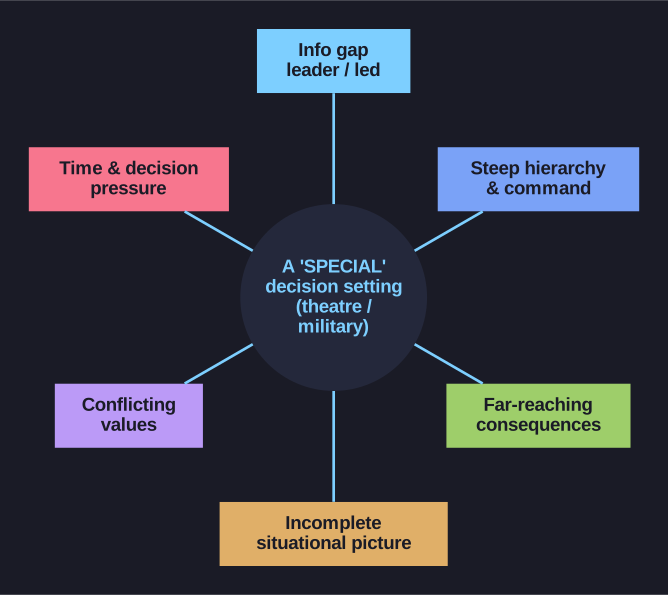
* Six properties cluster in a "special" setting — together they overwhelm ordinary, leisurely deliberation. *
Both settings share a cluster of properties that ordinary deliberation isn't built for:
- Hierarchy / command authority (Befehlsgewalt) — someone is empowered to give orders, and others are bound to follow.
- Information asymmetry between leader and led — the person in charge often sees more (or different) information than the people executing.
- Time and decision pressure — choices must be made now, not after a comfortable debate.
- Different values and concerns among everyone involved — a surgeon, an anaesthetist and a trainee may weigh the same moment differently.
- Incomplete information / situational picture (Lagebild) — you act on a partial view of reality.
- Far-reaching consequences of a wrong decision or wrong action.
The point isn't that critical thinking is suspended here — it's that where and when it happens has to be designed around these constraints, because you can't run a leisurely open inquiry while a patient is bleeding.
Tip: "Critical thinking in a crisis" is less about thinking harder in the moment and more about having done the thinking beforehand — and knowing the right moment to raise a concern.
Go deeper:
 Wikipedia — High reliability organization — how organisations stay safe while operating amid complexity and high risk.
- Wikipedia — Crew resource management — the communication, leadership and decision discipline these high-stakes settings run on.
Note saved — thanks!
Question
When you set out to analyse why a command-driven procedure — a surgical protocol, a weapons drill, a military order — is built the way it is, what five questions structure that analysis?
Answer
Five questions: why is it built this way, where does questioning fit, how can the led still contribute, what feedback improves it, and where does Speak-up fit?
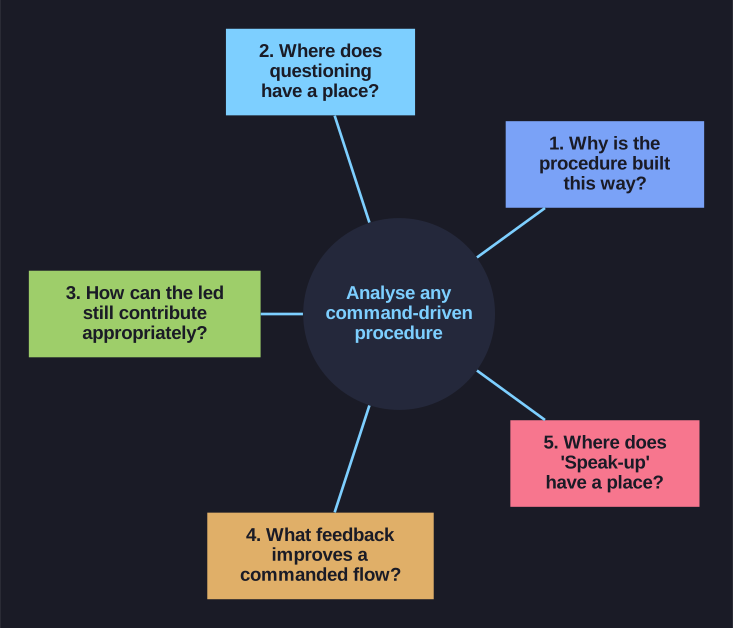
* One reusable lens: point these five questions at any command-driven procedure and its logic — and its safeguards — become visible. *
Rather than judging a command-driven setting as either "blind obedience" or "proper critical thinking", this lens interrogates it as a designed system:
- Why is the procedure the way it is — what wider context and constraints shaped it?
- Where does critical questioning have a place — which phase is built to absorb it?
- How is it ensured the led (or commanded) can still contribute appropriately — what channel lets them feed in?
- What feedback improves a commanded procedure — which loops carry lessons back into it?
- Where does "Speak-up" have a place — where is the protected exception for a safety concern?
Applied to the operating theatre, the drill hall, the resuscitation and the staff order alike, the five questions keep surfacing the same answer — the thinking is separated in time (rigorous before and after, decisive during), with Speak-up and structured feedback as the safeguards. The lens is the transferable tool; the three-phase split is what it repeatedly reveals.
Tip: Questions 2–5 map onto the safeguards you'll meet again and again — timing (Beobachten – Anmerken), contribution and Speak-up channels, and feedback loops (debrief, M&M, CIRS). Question 1 is just "understand the system before you criticise it."
Go deeper:
- Wikipedia — Socratic questioning — the disciplined use of structured questions to probe reasoning, assumptions and evidence.
- Wikipedia — After-action review — the structured "what feedback improves the procedure" step (question 4) as a formal practice.
Note saved — thanks!