Question
What do surveillance, observation and monitoring mean, and what types of surveillance are there?
Answer
Surveillance (mostly stationary) is targeted observation in a defined context by uninvolved third parties. Observation (mostly mobile) follows one person to record their behaviour without gaps. Monitoring watches processes to detect irregularities. Types: video, digital and self-surveillance.
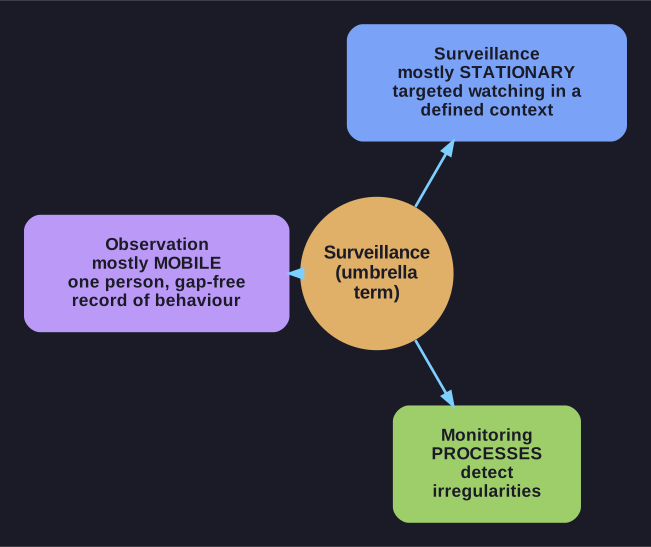
* Surveillance, observation and monitoring differ in what they watch and how *
The general term surveillance (Überwachung) covers three activities:
| Activity | Typically | Focus | Goal |
|---|---|---|---|
| Surveillance | Stationary | Objects or persons in a defined context | Targeted observation and data collection by third parties not involved in the events |
| Observation | Mobile | One person | Complete, gap-free record of their behaviour |
| Monitoring | Continuous | Processes | Detect irregularities |
Types of surveillance:
- Video surveillance: stations, squares, rooms.
- Digital surveillance: Wi-Fi tracking, electronic communication.
- Self-surveillance: through smartphones, apps and wearables, where people record data about themselves.
Go deeper:
 Wikipedia: Surveillance — overview of types, technologies and debates.
Note saved — thanks!
Question
What is a stakeholder, and what is the underlying insight of stakeholder theory?
Answer
A stakeholder is any individual or group with an interest in an organisation's decisions or activities — and the insight is that a firm cannot operate without regard for the system it operates in.
The definition is deliberately broad: it is interest in a decision or activity that makes someone a stakeholder, not a contract, not ownership, not proximity. That sweeps in employees, customers, suppliers, lenders, owners, the state, neighbouring residents, NGOs, and — in the versions that matter for environmental questions — future generations.
The contrast that gives the term its bite is with the shareholder view, on which the firm's obligations run to its owners and everything else is a constraint or a cost. Stakeholder theory denies that the firm is a closed system with one principal: it is embedded in a web of relationships, and the resources it depends on — trust, a licence to operate, skilled labour, a functioning legal order — are supplied by people who are not its shareholders.
From that follows the practical claim: an organisation that ignores the system it acts within is not being hard-nosed, it is mis-modelling its own situation. The interests of stakeholders are not external ethical constraints bolted onto the business; they describe the conditions under which the business can continue to exist.
Go deeper:
- Wikipedia: Stakeholder theory — Freeman's theory, its variants and the standard criticisms of it.
- Wikipedia: Stakeholder (corporate) — the concrete groups usually counted, including the contested ones such as future generations.

Note saved — thanks!