Question
Data can be in three different "states" — what are they, and why does each one need its own protection?
Answer
Data in transit (moving over a network), data in use (being processed in memory/CPU), and data at rest (stored on disk) — each is attacked differently, so each needs its own controls.
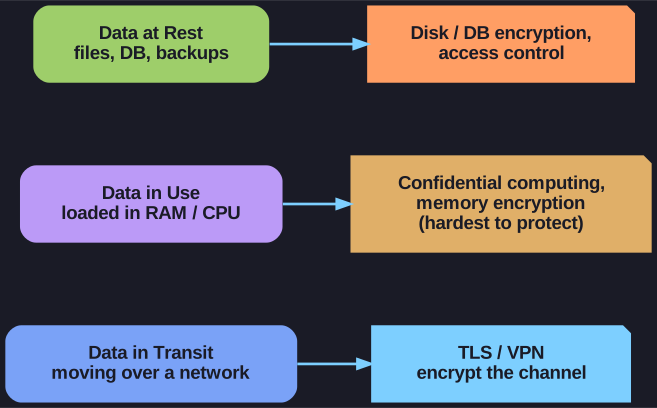
* Each state lives somewhere different, so each needs its own control. *
| State | Where it lives | Typical protection |
|---|---|---|
| In transit | flowing between two systems | TLS / VPN — encrypt the channel |
| In use | loaded in RAM / CPU registers | hardest to protect; confidential computing, memory encryption |
| At rest | files, databases, backups | disk/database encryption, access control |
Why it matters: people instinctively protect data at rest (the locked laptop) but forget transit (open Wi-Fi) and use (a process reading plaintext in memory). A complete security design has to cover all three. In use is the trickiest because the data must be decrypted to be computed on.
Tip: Remember the trio Transit – Use – Rest. Encryption mostly solves transit and rest; "in use" is still an open research area.
Go deeper:
 Data at rest / in transit / in use (Wikipedia) — the three states and why each is defended differently.

Note saved — thanks!
Question
What is the difference between a "leichte Störung" (light disturbance) and a "starke Störung" (heavy disturbance) when data is transmitted, and why does it matter for integrity checks?
Answer
A light disturbance flips a bit or two; a heavy one mangles whole chunks — and your integrity check has to be strong enough to catch both.
When Alice sends a file to Bob, noise on the line can corrupt it:
- Leichte Störung — a few bits flip. A simple checksum is usually enough to notice.
- Starke Störung — large parts are garbled. You need a method whose output changes drastically even for small input changes, so corruption can't slip through.
The core idea of integrity: Bob needs a way to tell "is what I received exactly what Alice sent?" He computes a check value over the received data and compares it to the one Alice attached. If they differ, the data changed.
Tip: Integrity ≠ confidentiality. We're not hiding the data here, just detecting whether it was altered.
Go deeper:
- Checksum (Wikipedia) — how a small check value flags accidental corruption in transmission or storage.

Note saved — thanks!