Question
How does the Diffie-Hellman Key Exchange (DHKE) work, step by step?
Answer
Alice and Bob each pick a secret exponent, exchange $g^a \mod p$ and $g^b \mod p$ publicly, then independently compute the shared secret $K = g^{ab} \mod p$.
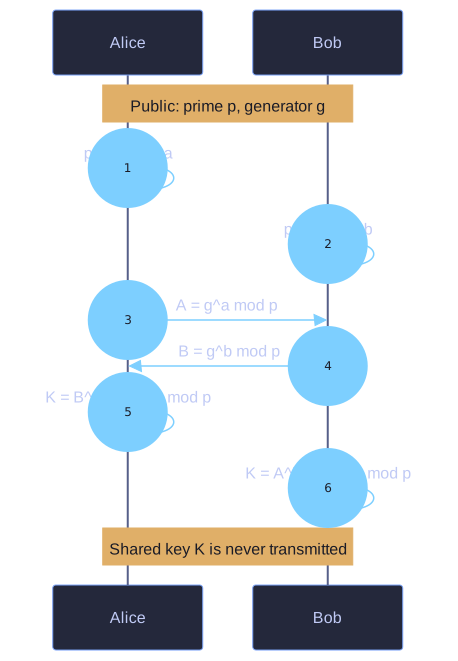
* Both sides reach $K = g^{ab} \mod p$; only $g^a$ and $g^b$ ever cross the wire. *
Public parameters: Prime $p$ and generator $g$ of $\mathbb{Z}_p^*$
Protocol:
- Alice: Chooses secret $a$, computes $A = g^a \mod p$, sends $A$ to Bob
- Bob: Chooses secret $b$, computes $B = g^b \mod p$, sends $B$ to Alice
- Alice computes: $K = B^a = (g^b)^a = g^{ba} \mod p$
- Bob computes: $K = A^b = (g^a)^b = g^{ab} \mod p$
Both arrive at the same key $K = g^{ab} \mod p$ without it ever crossing the channel!
What Eve sees: $p$, $g$, $A = g^a \mod p$, $B = g^b \mod p$. To find $K$, she'd need $a$ or $b$ — which requires solving the discrete logarithm problem (infeasible for large $p$).
Critical limitation: DH is a key exchange protocol only — it cannot encrypt messages or create signatures. Neither Alice nor Bob can choose what the shared key will be; it's determined by both random exponents.
Go deeper:
 Secret Key Exchange (Diffie-Hellman) — Computerphile — the paint-mixing intuition for the whole exchange.
 Diffie-Hellman key exchange — Wikipedia — canonical reference for the protocol and its math.

Note saved — thanks!
Question
Walk through a concrete numerical example of the Diffie-Hellman key exchange.
Answer
With $p = 31$ and generator $g = 3$: Alice picks $a = 8$, sends $3^8 \mod 31 = 20$. Bob picks $b = 6$, sends $3^6 \mod 31 = 16$. Both compute $K = 4$.
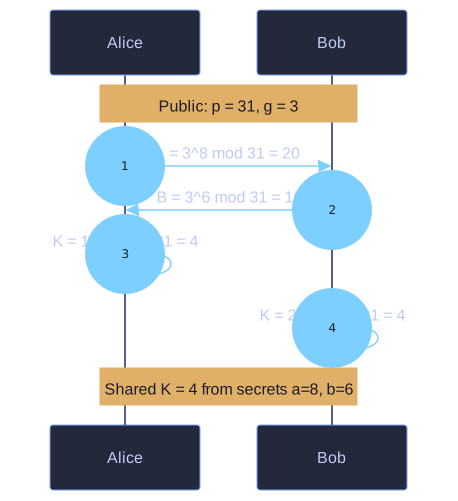
* Worked example: secrets $a = 8$ and $b = 6$ both land on the shared key $K = 4$. *
The reason to work it with tiny numbers is to watch the two sides land on the same $K$ without it ever crossing the wire — and to feel why the security evaporates once $p$ is small: here Eve really could just try every exponent, which is exactly the work that becomes hopeless when $p$ has hundreds of digits.
Setup: $p = 31$, $g = 3$ (a generator of $\mathbb{Z}_{31}^*$)
Alice (secret $a = 8$):
- Computes $A = 3^8 \mod 31 = 6561 \mod 31 = 20$
- Sends $A = 20$ to Bob
Bob (secret $b = 6$):
- Computes $B = 3^6 \mod 31 = 729 \mod 31 = 16$
- Sends $B = 16$ to Alice
Shared key computation:
- Alice: $K = 16^8 \mod 31 = 4$
- Bob: $K = 20^6 \mod 31 = 4$
Both get $K = 4$ — the shared secret!
Eve knows: $p = 31$, $g = 3$, $A = 20$, $B = 16$. She'd need to solve $3^a \equiv 20 \mod 31$ to find $a = 8$ — easy for small numbers, but infeasible when $p$ has 1000+ digits.
Go deeper:
- Diffie-Hellman, the Mathematics bit — Computerphile — works the modular exponentiation by hand.
- Diffie-Hellman key exchange — Wikipedia — includes its own worked numeric example.
Note saved — thanks!