Question
What is a multiple-access scheme, and how do FDMA and TDMA each divide the radio medium?
Answer
A multiple-access scheme is the rule that lets many subscribers share one radio medium without colliding. FDMA gives each user a separate frequency band; TDMA gives each user a separate time slot.
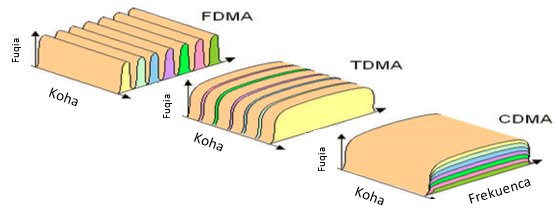
* FDMA, TDMA and CDMA splitting one shared channel. — KaltrinaMu, CC BY-SA 4.0, via Wikimedia Commons. *
When several stations transmit on the same medium at the same time, their signals collide and produce interference. A multiple-access scheme isolates the participants so they can coexist. Every mobile generation defines one for its users (and a scheme can be imposed per user or per cell).
FDMA — Frequency Division Multiple Access:
- Separate, non-overlapping frequency bands
- A user gets exclusive use of one frequency for the entire duration of the connection
- Analogy: each conversation on its own radio station
TDMA — Time Division Multiple Access:
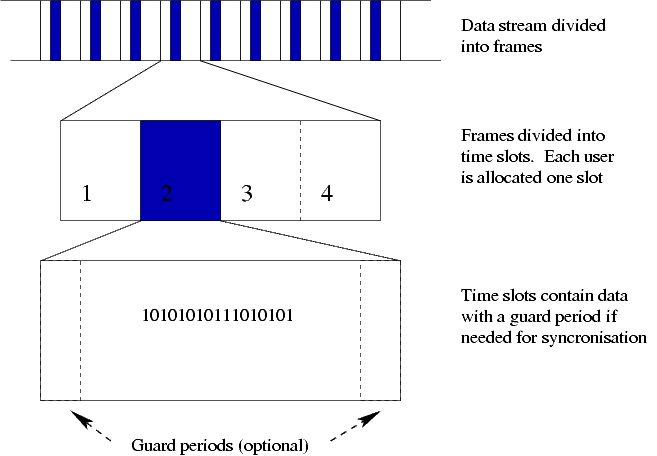
- Separate, non-overlapping time slots within a repeating frame
- A user gets exclusive use of one time slot for the duration of the transmission
- Analogy: everyone shares one frequency but takes strict turns by the clock
Why it matters: FDMA and TDMA both rely on hard, exclusive partitions — once all frequencies (FDMA) or all slots (TDMA) are handed out, no further users fit. This is the conceptual opposite of CDMA, where everyone shares all frequency and all time and is separated only by code.
Go deeper:
 TDMA / FDMA / CDMA / OFDMA / SDMA — multiple access, visualized (YouTube) — animated side-by-side of how each scheme partitions the same resource.
 Murata — Multiplexing & multiple access (1): FDMA / TDMA / CDMA — clean vendor diagrams contrasting frequency-, time-, and code-division on one bandwidth.
 Frequency-division multiple access (Wikipedia) — the frequency-band partition and its guard-band cost.
- Time-division multiple access (Wikipedia) — the time-slot/frame model used in GSM and other 2G systems.
Note saved — thanks!
Question
What is the detailed structure of a GSM TDMA frame and burst?
Answer
A GSM frame consists of 8 time slots of 577 microseconds each (total frame = 4.615 ms), and each burst contains guard spaces, tail bits, user data, and a training sequence.
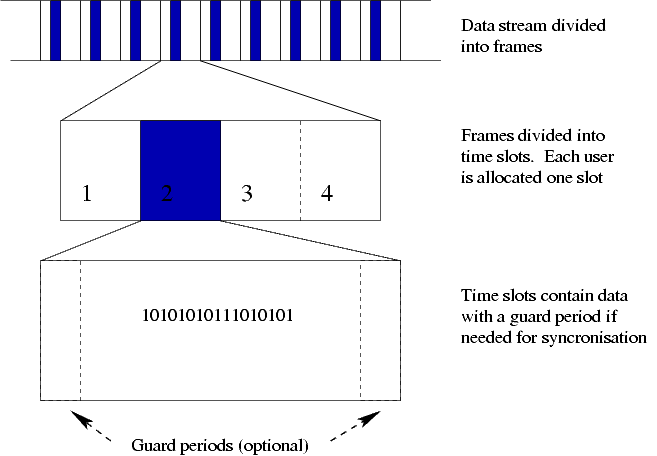
* GSM TDMA frame split into eight burst slots. — Mozzerati, CC BY-SA 3.0, via Wikimedia Commons. *
GSM frame structure:
- Total bandwidth (GSM-900): 124 frequency channels, each 200 kHz wide
- Each channel is divided into 8 time slots (TDMA)
- One time slot = 577 µs = one burst
- One TDMA frame = 8 slots = 4.615 ms
Burst structure (within one 577 µs slot):
| Guard | Tail | User data | S | Training | S | User data | Tail | Guard |
| ~8.25 |  3   |    57     | 1 |    26    | 1 |    57     |  3   | ~8.25 |
The content fields total 148 bits spanning 546.5 µs; the remaining time of the 577 µs slot is the guard period (~8.25 bit-times).
- Guard space — empty time to prevent overlap with adjacent slots (timing uncertainty)
- Tail bits — known bit patterns at both ends to help the receiver synchronize and bound the equalizer
- S — stealing flags — 1 bit on each side of the training sequence; when set, the user-data fields are "stolen" to carry urgent signaling (FACCH) instead of voice
- Training sequence — a known 26-bit pattern in the middle used for channel estimation (the receiver learns the current channel distortion and compensates for it)
- User data — 2 × 57 bits = 114 bits of actual payload per burst
Data rate calculation: 114 useful bits per 4.615 ms frame = ~24.7 kbps raw data rate per time slot. After channel coding overhead, GSM delivers about 13 kbps for voice (using the Full Rate codec).
Go deeper:
- GSM slot & burst structure (Electronics Notes) — field-by-field breakdown of the normal burst (tail / data / training / stealing / guard), plus the access, sync and frequency-correction burst variants.
Note saved — thanks!