Question
Why were 4G and 5G needed, and what three factors define the performance of any mobile system?
Answer
Mobile data traffic was growing so fast that the industry prepared for a 1000x increase — and since radio resources were already heavily utilized, fundamentally better technology was needed. Performance is defined by three factors: number of antennas, amount of spectrum, and the level of interference.
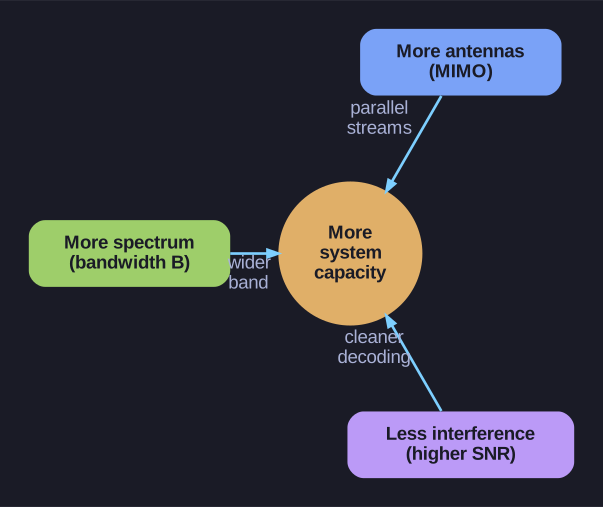
* The three levers feed one outcome — capacity; Shannon's law C = B·log₂(1+SNR) shows why more bandwidth and a higher SNR raise the ceiling, while MIMO multiplies it. *
The traffic explosion:
Smartphones, video streaming, and mobile apps drove exponential growth in data demand. The industry's planning target was a 1000-fold increase in traffic — something incremental tweaks to 3G could never deliver, because the existing radio resources were already squeezed close to their limits.
The three performance levers of any mobile system:
| Factor | Effect |
|---|---|
| Number of antennas | More antennas → more parallel data streams (MIMO) → more throughput |
| Size of the radio spectrum | More frequencies available → more capacity |
| Interference level | Less interference → more data can be decoded correctly |
Every improvement in 4G and 5G attacks at least one of these three levers. This is a useful mental framework: when you hear about any new mobile feature (carrier aggregation, massive MIMO, small cells, beamforming), ask yourself — which of the three levers is it pulling?
Go deeper:
 Shannon–Hartley theorem (Wikipedia) — the capacity law C = B·log₂(1 + SNR) behind two of the three levers: capacity rises with bandwidth B (more spectrum) and with the signal-to-noise ratio (less interference), and MIMO multiplies the whole thing.

Note saved — thanks!
Question
Which new features did the 4G/5G standards introduce to cope with traffic growth, and which lever does each pull?
Answer
More spectrum (new frequency allocation + OFDMA), more antennas (MIMO, multipoint transmission, relaying), more cells (small cells, home base stations), and integration of other networks like WLAN.
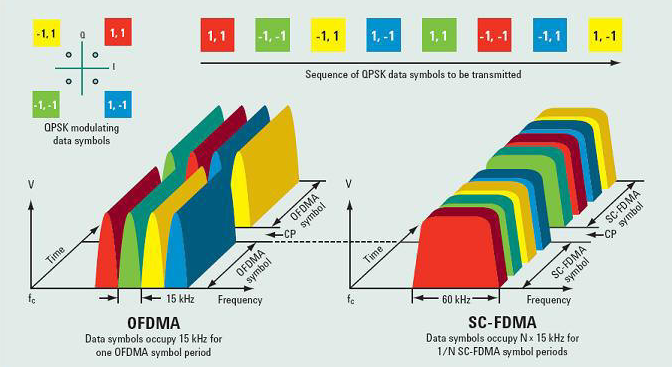
* OFDMA vs SC-FDMA, LTE's new multiplexing. — Oriol.subirana, CC BY-SA 3.0, via Wikimedia Commons. *
Feature map:
| Lever | New features |
|---|---|
| More spectrum | New frequency allocation scheme; new multiplexing technique: OFDMA |
| More antennas | MIMO technology, multipoint transmission and reception, relaying |
| More cells | Small cells, home base stations (Home eNodeBs) |
| Other networks | WLAN integration (offloading traffic to Wi-Fi) |
Why this matters: 4G wasn't one big invention but a coordinated package of improvements. OFDMA replaced CDMA as the access scheme, MIMO multiplied throughput per Hz, small cells multiplied spectrum reuse per area, and Wi-Fi offloading reduced the load on licensed spectrum entirely.
Go deeper:
 OFDM Explained — with MATLAB examples (Waveform Academy) — watch the orthogonal subcarriers overlap without interfering; the visual that makes OFDM/OFDMA finally click.
- 4G LTE Modulation: OFDM / OFDMA / SC-FDMA (Electronics Notes) — why LTE uses OFDMA downlink but SC-FDMA uplink (the SC-FDMA low peak-to-average ratio saves handset battery), with resource-block detail Wikipedia skips.
- Orthogonal frequency-division multiple access (Wikipedia) — the canonical reference, kept for its subcarrier/resource-grid diagrams that feed the image carousel.
Tip: Remember the slogan "more spectrum, more antennas, more cells" — almost every modern radio feature falls into one of these three buckets.

Note saved — thanks!