Question
What three impairments make a wireless link harder than a wired one, and what is the end result?
Answer
Path loss, interference, and multipath propagation all degrade a radio signal, leaving the receiver with a blurred, indistinct waveform.
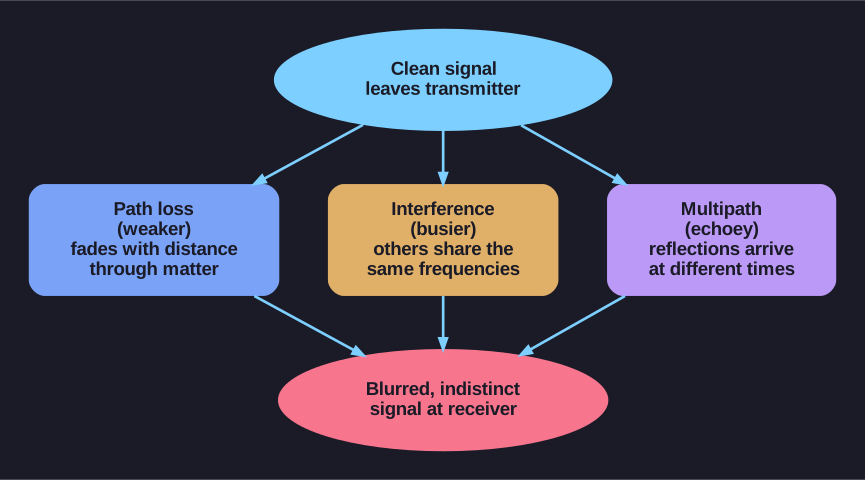
* Three impairments — weaker, busier, echoey — blur the received signal. *
On a cable, data transmission is comparatively easy — the signal stays confined to the wire. Over the air, three effects work against you:
1. Path loss (Pfadverlust):
- The radio signal gets weaker the farther it travels through matter (air, walls, rain, your body)
- This is why distant phones need more transmit power and why cells have a finite radius
2. Interference (Interferenz):
- Other sources share the same frequencies — e.g., the 2.4 GHz band is used by Wi-Fi, Bluetooth, cordless phones, and even microwave ovens
- Electrical devices (motors) also emit noise that corrupts the signal
3. Multipath propagation (Mehrwegausbreitung):
- The signal reflects off buildings, the ground, and objects, so multiple copies reach the antenna at slightly different times
- These delayed copies add up constructively or destructively, smearing the symbols together (this is what causes frequency-selective fading)
The result: a blurred, indistinct signal — fuzziness at reception. Everything else in this topic (error correction, adaptive modulation, frequency hopping, power control) exists to fight one or more of these three problems.
Tip: Remember the trio as "weaker, busier, echoey" — path loss makes it weaker, interference makes the band busier, multipath adds echoes.
Go deeper:
 Multipath propagation (Wikipedia) — how reflected copies arriving at different times cause fading and smear symbols together.
- Path loss (Wikipedia) — why signal power density drops with distance and what governs the rate of decay.

Note saved — thanks!
Question
What three techniques are used to deal with errors caused by poor signal quality in wireless transmission?
Answer
CRC error detection codes, redundancy (retransmission), and modulation schemes — each addresses errors at a different layer.
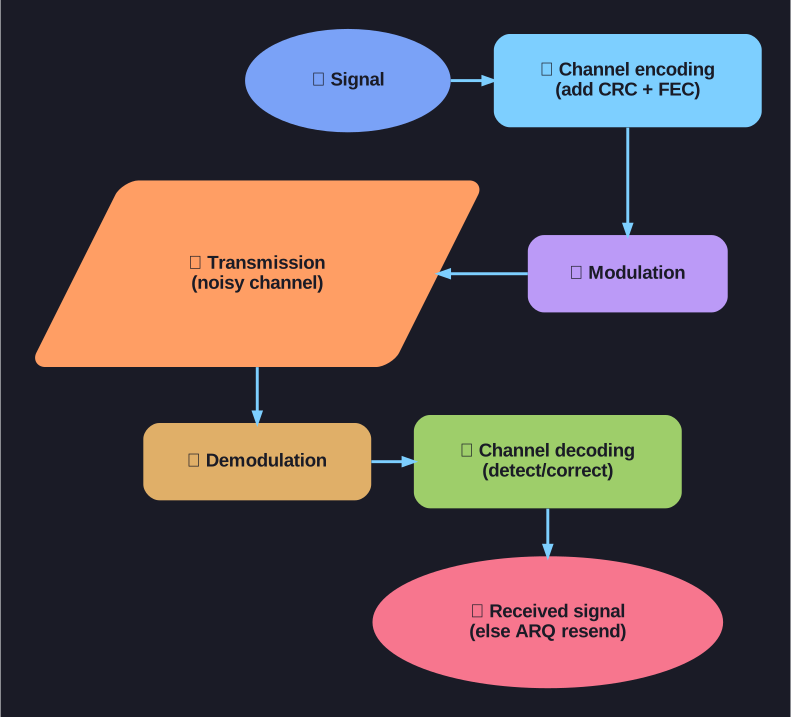
* CRC/FEC encoding, modulation, the noisy channel, decoding, ARQ resend. *
1. CRC (Cyclic Redundancy Check) error detection:
- Adds check bits to transmitted data so the receiver can detect if bits were flipped during transmission
- Doesn't correct errors — just detects them, triggering a retransmission request (ARQ)
2. Redundancy (retransmission):
- Simply send the data again if errors are detected
- Trades bandwidth for reliability — works well when errors are infrequent
- Forward Error Correction (FEC) adds redundant bits proactively so the receiver can fix errors without retransmission
3. Modulation schemes:
- Modulation = encoding digital bits onto an analog carrier wave by varying its amplitude, frequency, or phase
- Different modulation schemes offer different trade-offs between speed and robustness
- The word comes from Latin modulatio = rhythm/measure
The transmit chain: Signal → Channel encoding (add redundancy) → Modulation → Transmission → Demodulation → Channel decoding (error correction) → Received signal
Go deeper:
- Cyclic redundancy check (Wikipedia) — how appended check bits detect (but don't correct) flipped bits, triggering retransmission.
- Forward error correction (Wikipedia) — the proactive redundancy that fixes errors without retransmission, and the reliability-vs-rate trade-off.

Note saved — thanks!