Question
What is the difference between Network Layer (L3) and Data Link Layer (L2) addresses?
Answer
L3 uses IP addresses to deliver the packet end-to-end (source to final destination, unchanged); L2 uses MAC addresses to deliver the frame one hop at a time and changes at every hop.
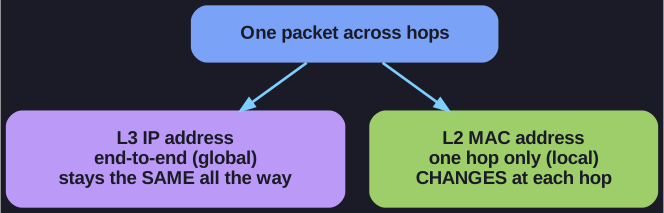
* IP is end-to-end and constant; MAC is hop-local and rewritten each hop. *
| Layer | Address Type | Purpose |
|---|---|---|
| Network Layer (L3) | IP Address | Delivers the IP packet from original source to final destination (global/end-to-end) |
| Data Link Layer (L2) | MAC Address | Delivers the frame from one NIC to another NIC on the same network (local/hop-to-hop) |
Key insight:
- L3 (IP) addresses remain the same throughout the journey
- L2 (MAC) addresses change at each hop as the frame moves between networks
Go deeper:
 Host to Host through a Router — Practical Networking — shows the L3 header staying fixed while L2 is regenerated each hop.
- MAC address — the Layer-2 address that only has meaning on one link.

Note saved — thanks!
Question
What is the default gateway and why is it important for hosts?
Answer
The default gateway is the local router interface address a host sends packets to when the destination is on another network; without it a host can only reach its own local network.

* On-subnet traffic is delivered directly; anything off-subnet goes to the default gateway, which must itself sit in the host's own network. *
Default Gateway on a Host:
The default gateway is used when a host needs to send a packet to a device on another network.
Key requirements:
- The default gateway address is the router interface connected to the host's local network
- The host's IP address and the router interface must be in the same network
Example:
- PC1 (192.168.10.10/24) wants to reach PC3 (192.168.11.10/24)
- PC1's default gateway = R1's G0/0/0 interface (192.168.10.1)
- PC1 addresses packet to PC3's IP but forwards frame to R1's MAC
How hosts learn the default gateway:
- Manual configuration - Administrator enters gateway IP
- DHCP - Server provides gateway address automatically
- IPv6 Router Advertisement - Router sends RA messages with gateway info
Why the gateway must be on the same network: A host can only deliver a frame directly to a device in its own subnet (it ARPs for the gateway's MAC). If the configured gateway address sat in a different network, the host could never resolve or reach it, so it could not forward any off-network traffic at all.
Critical: Without a valid default gateway, hosts can only communicate with devices on their local network.
Go deeper:
- Practical Networking — Host to Host through a Router — step-by-step how a host frames a packet to its default gateway to reach a remote network.
- Default gateway (Wikipedia) — the forwarding host a device uses when no specific route matches the destination.
- Dynamic Host Configuration Protocol (Wikipedia) — how DHCP hands the gateway address to a host automatically.

Note saved — thanks!