Question
What problem does EtherChannel solve, and why can't you just add more cables between switches?
Answer
EtherChannel solves the problem of STP (Spanning Tree Protocol) blocking redundant links — it bundles multiple physical links into one logical link that STP treats as a single connection.
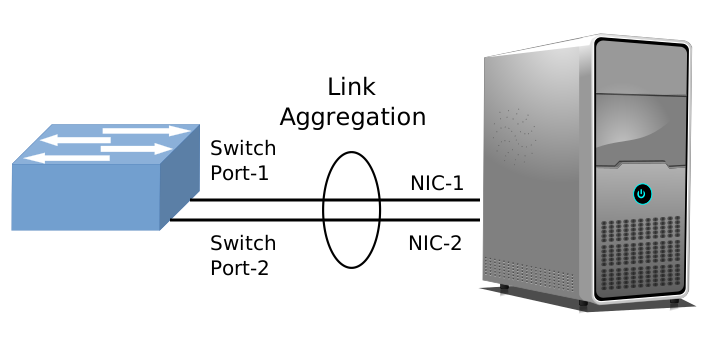
* Several physical links bundled as one logical link. — wdwd, CC BY-SA 4.0, via Wikimedia Commons. *
When you connect multiple cables between two switches to increase bandwidth, STP will block all but one to prevent loops. This means your extra cables sit idle — wasted investment.
EtherChannel (link aggregation) solves this by grouping multiple physical Ethernet links into one logical link. STP sees it as a single connection, so:
- All physical links remain active simultaneously
- You get combined bandwidth (e.g., 4 × 1 Gbps = 4 Gbps logical link)
- Fault tolerance — if one physical link fails, the others keep working
- Load balancing across the bundled links
Tip: Think of EtherChannel as "tricking" STP into seeing one fat pipe instead of multiple thin ones. STP won't block a single link.
Go deeper:
 Link aggregation (Wikipedia) — bandwidth scaling and redundancy as the motivation, and why STP would otherwise block redundant parallel links.

Note saved — thanks!
Question
What is a port channel interface, and how does it relate to EtherChannel?
Answer
A port channel is the virtual (logical) interface created when physical interfaces are bundled into an EtherChannel.
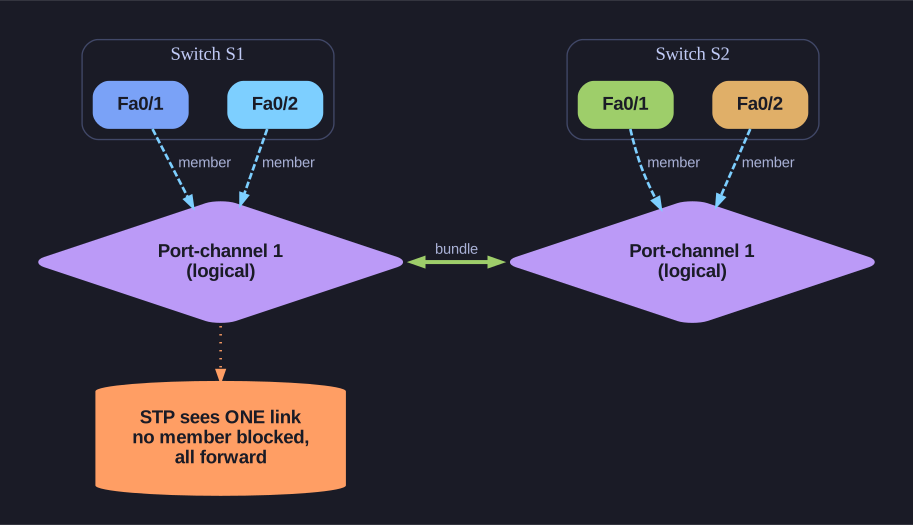
* Member ports bundled into one port channel. *
EtherChannel was originally developed by Cisco as a LAN (Local Area Network) switch-to-switch technique for grouping several Fast Ethernet or Gigabit Ethernet ports into one logical channel.
Key terminology:
- EtherChannel — the technology/concept of link aggregation
- Port channel — the resulting virtual interface (e.g.,
Port-channel 1) - Member interfaces — the physical ports bundled into the port channel
How it works:
- The physical interfaces are bundled together into a port channel interface
- Configuration applied to the port channel automatically applies to all member interfaces
- STP (Spanning Tree Protocol), routing protocols, and other features interact with the port channel, not individual links
- The switch treats the bundle as one logical interface for all purposes
Go deeper:
 EtherChannel Protocols and Configuration (FlackBox) — how the logical port-channel is built from physical members, with SU/P flags.
- What is EtherChannel (Study-CCNA) — the one-logical-link concept and why STP sees the bundle as one link.
Note saved — thanks!