Question
What is the "data dilemma," and how does differential privacy resolve it?
Answer
Companies need data to improve products while users need privacy — differential privacy satisfies both by adding calibrated noise that hides individuals but preserves group patterns.
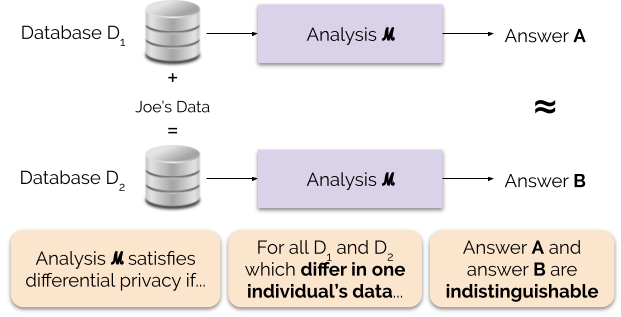
* Including or excluding one person barely changes the output. — Near, Darais & Boeckl, Public domain, via Wikimedia Commons. *
The tension: organizations need real usage data (measuring beats guessing), but individuals need privacy because personal information can be sensitive and harmful if exposed. These look contradictory.
Differential privacy (DP) dissolves the dilemma. It's a mathematical technique that lets you collect meaningful insights about groups of users while protecting the privacy of any individual. The trick: add carefully calibrated statistical noise to the data (or query results) in a way that preserves overall patterns but makes it impossible to identify a specific person or their contribution.
Tip: DP shifts the question from "is this dataset anonymous?" to "does adding/removing one person change the output?" If not, that person is protected.
Go deeper:
 Differential privacy (Wikipedia) — the "does adding/removing one person change the output?" framing with the epsilon budget.
- The Algorithmic Foundations of Differential Privacy (Dwork & Roth, PDF) — the definitive monograph behind the promise.
Note saved — thanks!
Question
Why does traditional anonymization (just removing names) fail to protect privacy?
Answer
Stripping names doesn't make data anonymous — leftover attributes can be re-linked to other datasets to re-identify people, and you must trust the company to anonymize correctly in the first place.
Three weaknesses sink naive anonymization:
- Trust issues — anonymization happens on the company's servers, so you must trust them to actually strip identifying information properly.
- Linkage attacks — "anonymous" data can be cross-referenced with other datasets to recover real identities, defeating the whole point.
- Not really anonymous — even without names, combinations of ordinary attributes can uniquely pinpoint individuals.
The classic evidence: research found that roughly 87% of Americans can be uniquely identified from just three data points — ZIP code, birth date, and gender. Latanya Sweeney famously used exactly this to re-identify the Massachusetts governor's "anonymized" medical records.
Tip: This is why differential privacy exists. DP gives a provable guarantee that holds even against an attacker who already has side data to link against — the exact scenario where anonymization collapses.
Note saved — thanks!