Question
In AT&T syntax, what is the operand order and how does it differ from Intel syntax?
Answer
AT&T puts the source first, destination second (mov src, dst); Intel is the reverse (mov dst, src).
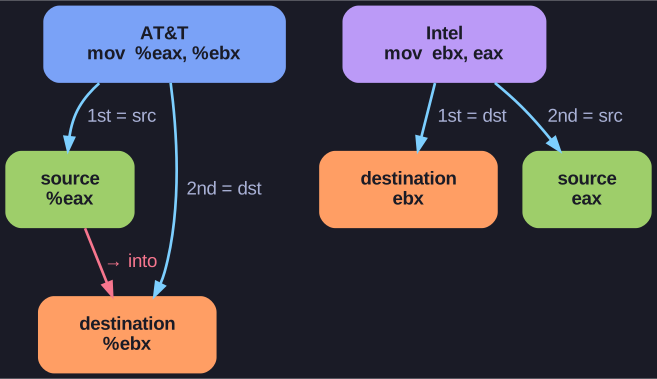
* AT&T lists the source first and destination second (read the comma as an arrow, into); Intel reverses it. *
| AT&T | Intel | Meaning |
|---|---|---|
mov %eax, %ebx |
mov ebx, eax |
ebx = eax |
add %ecx, %edx |
add edx, ecx |
edx = edx + ecx |
sub $5, %eax |
sub eax, 5 |
eax = eax - 5 |
Mnemonic: AT&T reads like an arrow: mov %eax, %ebx means "move eax into ebx."
Go deeper:
 GNU as: AT&T vs Intel syntax — the assembler's own list of the operand-order and prefix differences.
- x86 assembly language (Wikipedia) — syntax-comparison table plus the wider register/instruction context.
Note saved — thanks!
Question
What prefixes does AT&T syntax use for registers, immediates, and how does it format memory operands?
Answer
Registers are prefixed with %, immediate constants with $, and memory operands are written offset(base, index, scale).
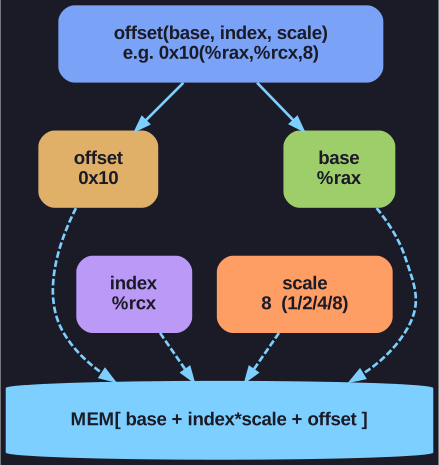
* offset(base, index, scale) resolves to MEM[base + index*scale + offset]; scale is limited to 1, 2, 4, or 8. *
| Element | AT&T | Intel equivalent |
|---|---|---|
| Register | %eax |
eax |
| Immediate | $5, $0x10 |
5, 10h |
| Memory | 8(%rbp) |
[rbp + 8] |
| Scaled | (%rdi,%rsi,4) |
[rdi + rsi*4] |
| Full | 0x10(%rax,%rcx,8) |
[rax + rcx*8 + 0x10] |
Memory formula: offset(base, index, scale) = MEM[base + index*scale + offset]
Scale can only be 1, 2, 4, or 8. Omitted parts default to 0.
Go deeper:
- GNU as: AT&T operand notation — authoritative definition of the % / $ prefixes and memory-operand form.
- x86 assembly language (Wikipedia) — explains addressing modes and how the scaled-index form maps to hardware.
Note saved — thanks!