Quiz Entry - updated: 2026.07.30
How did the network design simplify from 3G UMTS to LTE?
LTE collapsed the 3G hierarchy: the RNC disappeared, the eNodeB absorbed its functions, and the core was reorganized into a clean control plane (MME) and user plane (Serving/PDN Gateway).
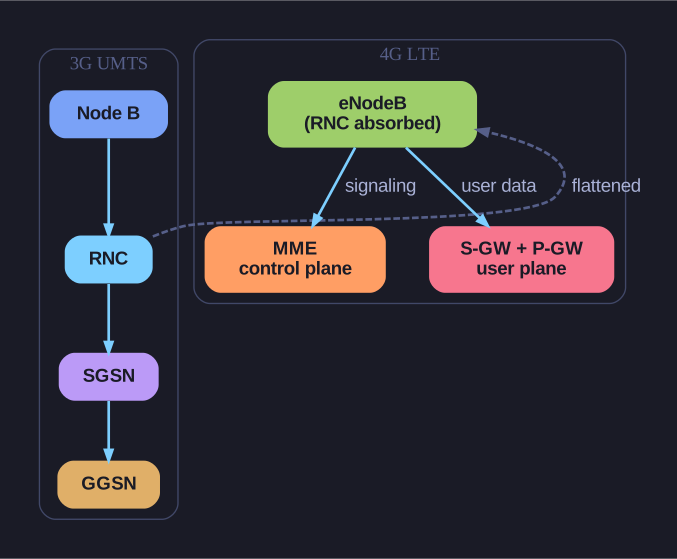
* 3G vs 4G: the RNC folds into the eNodeB; core splits control/user planes. *
Side-by-side comparison:
| Plane | 3G UMTS | LTE |
|---|---|---|
| Radio access | Node B + RNC (two levels) | eNodeB only (flat) |
| Control plane | SGSN (signaling parts) | MME |
| User plane | SGSN + GGSN | S-GW + P-GW |
What was gained:
- Fewer hops — user data passes through fewer boxes → lower latency
- Clean separation — control plane (signaling) and user plane (data) have dedicated elements that scale independently
- Simpler operations — fewer element types to deploy and maintain
The big picture: each generation pushed intelligence outward to the base station and simplified the core: GSM had BTS→BSC→MSC, UMTS had NodeB→RNC→SGSN/GGSN, LTE has just eNodeB→EPC. 5G continues this trend with a cloud-native core.
Go deeper:
 System Architecture Evolution (Wikipedia) — the flat all-IP redesign that removed the RNC and split control plane (MME) from user plane (S-GW/P-GW).