Quiz Entry - updated: 2026.10.15
How do symmetric and asymmetric cryptography compare, and why are they used together in practice?
Symmetric crypto is fast but requires pre-shared keys. Asymmetric crypto solves key distribution but is much slower. The hybrid approach combines both: asymmetric for key exchange, symmetric for bulk encryption.
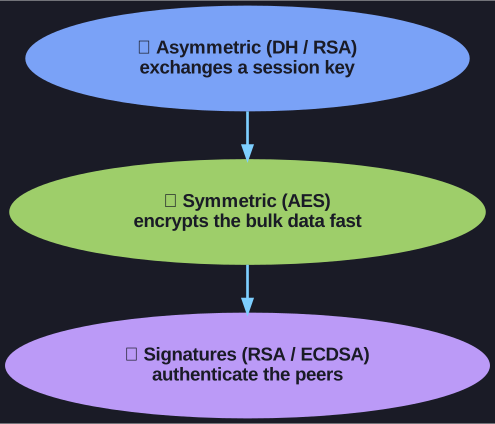
* The pattern behind TLS: slow asymmetric tools set up a fast symmetric channel. *
| Property | Symmetric | Asymmetric |
|---|---|---|
| Key sharing | Must share secret key in advance | Only public keys need to be distributed |
| # Keys for n users | $O(n^2)$ — quadratic growth | $O(n)$ — linear growth |
| Speed | Very fast (AES: hardware-accelerated) | 100-1000x slower |
| Key size (2023) | 128-256 bits (AES) | 3072+ bits (RSA/DH), 256+ bits (ECC) |
| Operations | Encryption only | Encryption, signatures, key exchange |
| Examples | AES, ChaCha20 | RSA, DH, ElGamal, ECC |
The hybrid approach (used in TLS, PGP, etc.):
- Use DH/ECDH or RSA to securely exchange a session key (e.g., AES-256 key)
- Use the session key with AES to encrypt the actual data
- Use RSA/ECDSA signatures for authentication
Tip: In practice, you almost never see pure asymmetric encryption. Even "RSA encryption" in TLS is really just RSA encrypting an AES key.
Go deeper:
 Hybrid cryptosystem — Wikipedia — how TLS/SSH pair asymmetric key exchange with symmetric bulk encryption.