Quiz Entry - updated: 2026.07.30
How do you recognize array access in assembly?
Look for scaled-index addressing base(,%index,scale), where the scale (1/2/4/8) equals the element size in bytes.
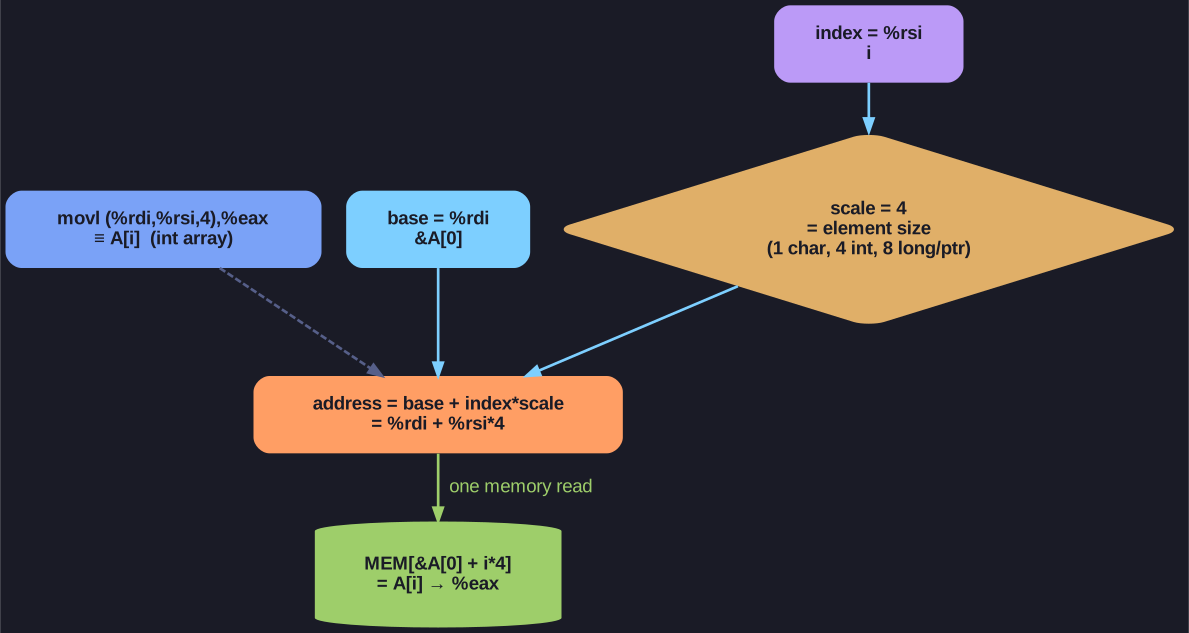
* Scaled-index addressing base(,index,scale): the scale (1/2/4/8) equals the element size in bytes. One memory access = contiguous array element MEM[&A[0] + i*scale]. *
# eax = A[i] (int array, 4 bytes per element)
movl (%rdi,%rsi,4), %eax

# rax = A[i] (long/pointer array, 8 bytes per element)
movq (%rdi,%rsi,8), %rax
Common scales and what they mean:
| Scale | Element size | Type |
|---|---|---|
| 1 | 1 byte | char, byte |
| 2 | 2 bytes | short |
| 4 | 4 bytes | int, float |
| 8 | 8 bytes | long, double, pointer |
Multidimensional array A[i][j] with M columns:
# index = i*M + j, then scale by element size
imul $M, %rdi, %rax
add  %rsi, %rax
movl (%rcx,%rax,4), %eax
vs pointer array (array of pointers to rows):
# First dereference: get row pointer
mov  (%rdi,%rsi,8), %rax
# Second dereference: get element
mov  (%rax,%rdx,4), %eax
Two memory accesses = multilevel (pointer array). One = contiguous 2D array.
Go deeper:
 Array data structure — address computation (Wikipedia) — Gives the base + c·i element-address formula that scaled-index addressing implements in hardware.
- LEA effective-address computation (felixcloutier) — LEA/mov both use the base+index*scale+disp operand form; reference for how the scaled address is built.