Quiz Entry - updated: 2026.07.30
How do you recognize struct field access in assembly?
Look for fixed constant offsets off one base pointer (0(%rax), 4(%rax), 12(%rax)) — each offset is a field's position within the struct.
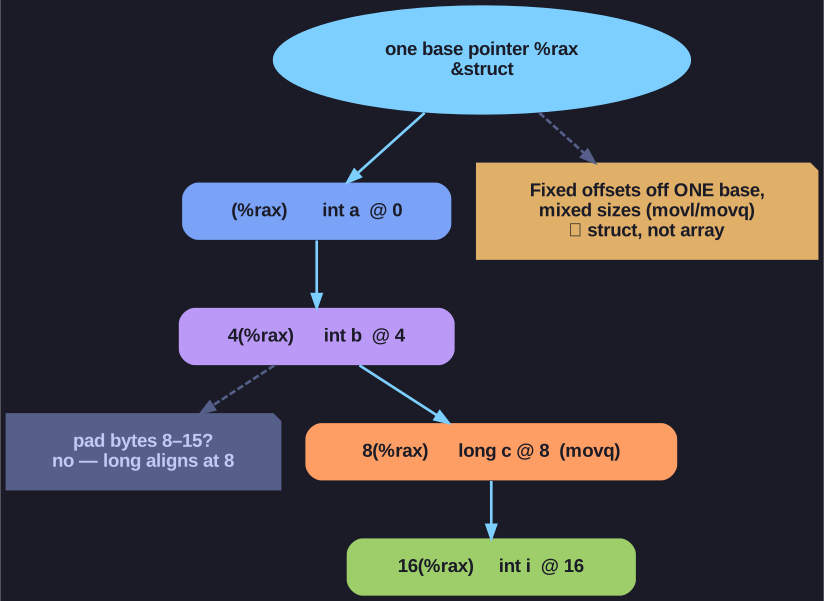
* Fixed constant offsets off one base pointer (0, 4, 8, 16), often with mixed access sizes (movl for int, movq for long) and alignment padding — the signature of struct field access versus a scaled array index. *
# Access struct field at offset 12
movl 12(%rax), %edx

# Access struct field at offset 0 (first field)
movl (%rax), %edx
Example struct:
struct rec {
    int a;       // offset 0
    int b;       // offset 4
    long c;      // offset 8 (aligned)
    int i;       // offset 16
};
How to identify structs vs arrays:
- Struct: Different constant offsets, potentially different instruction sizes (
movlfor int at offset 0,movqfor long at offset 8) - Array: Scaled index with uniform element size
Tip: If you see multiple accesses to the same base register with different fixed offsets (0(%rax), 4(%rax), 12(%rax)), it's a struct. Map the offsets to figure out field sizes and padding.
Go deeper:
 Record / struct — memory layout (Wikipedia) — Describes fields in consecutive memory with alignment padding, matching the offset map in the diagram.
- Stack frame layout on x86-64 (Eli Bendersky) — Grounds fixed-offset base-pointer addressing (disp(%reg)) used to reach struct fields on x86-64.