Quiz Entry - updated: 2026.07.30
How do you systematically approach an unknown assembly function?
Work in five steps: identify the inputs (argument registers) and output (%rax at ret), map the control flow, trace each path, annotate with pseudocode, then name what it computes.
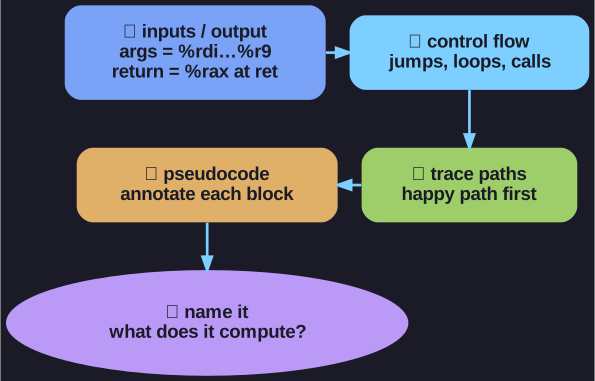
* Five steps: inputs/output, control flow, trace, pseudocode, name it. *
Step 1 — Identify inputs and outputs:
- What registers are read before being written? Those are arguments (
%rdi,%rsi,%rdx,%rcx,%r8,%r9) - What's in
%eax/%raxatret? That's the return value
Step 2 — Map the control flow:
- Find all
jmp,je,jne, etc. — draw arrows - Identify loops (backward jumps) and branches (forward jumps)
- Find
callinstructions — note what functions they call
Step 3 — Trace each path:
- Start at the top, follow the "happy path" first
- Then trace what happens when conditions fail
Step 4 — Annotate with pseudocode:
# eax = rdi + rsi*4 → "eax = a + b*4"
# cmp + jl → "if (a < b)"
Step 5 — Name it:
- What does it compute? String compare? Sum? Search?
GDB shortcuts:
(gdb) disas func_name
(gdb) break *func_address
(gdb) info registers
(gdb) x/... $rsp
Go deeper:
