Quiz Entry - updated: 2026.07.30
How does LTE separate the control plane from the data plane, and what runs on each?
LTE splits the network into a control plane (eNodeB → MME, with new protocols for mobility management, security, and authentication) and a data plane (eNodeB → S-GW → P-GW, with new link/physical-layer protocols and extensive tunneling).
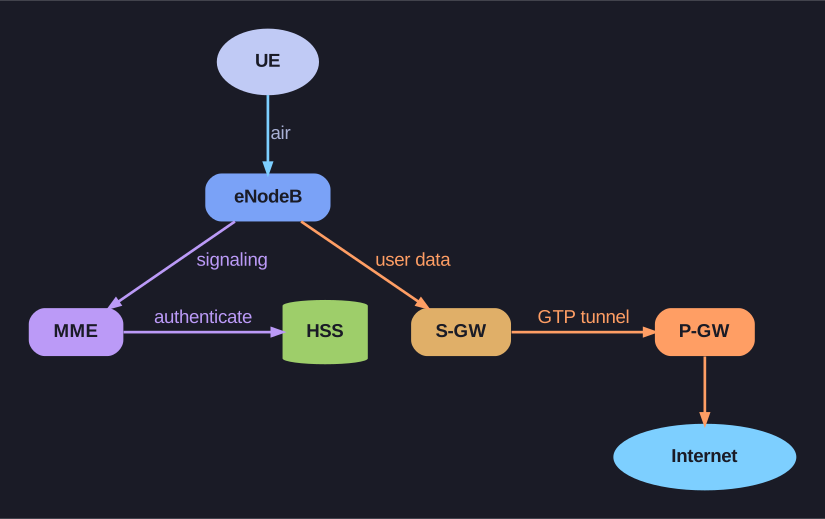
* Control plane (MME/HSS) vs user plane (S-GW/P-GW to the Internet). *
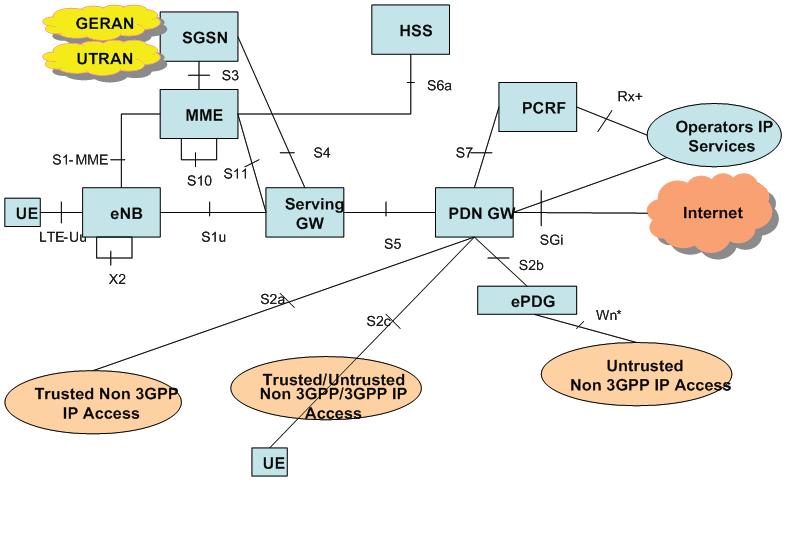
* LTE architecture: control plane vs data plane., Public domain, via Wikimedia Commons. *
Control plane (Steuerungsebene):
- Path: base station → MME (with HSS behind it)
- Carries signaling: mobility management, security, authentication
- New protocols designed specifically for these tasks
Data plane (Datenpfad):
- Path: base station → S-GW → P-GW → internet
- Carries the user's actual IP packets
- New protocols at the link and physical layers
- Extensive use of IP tunnels to make mobility easy: moving devices = re-pointing tunnels
Why separate them?
- Independent scaling — a network with many idle-but-registered devices needs signaling capacity; a network with heavy streaming needs data capacity. Separate planes scale separately.
- Specialized optimization — signaling needs reliability; data needs throughput.
- Cleaner security — authentication infrastructure is isolated from the packet-forwarding path.
Looking forward: this control/user-plane separation (CUPS) becomes even more radical in 5G, where the core is decomposed into cloud-native microservices.
Go deeper:
 System Architecture Evolution (Wikipedia) — the explicit control/user-plane split (and the later CUPS step that 5G inherits).