How does SNR relate to modulation scheme selection, and what is the trade-off?
Higher SNR allows more aggressive modulation (more bits per symbol = higher throughput), but aggressive modulation is more susceptible to errors at lower SNR.
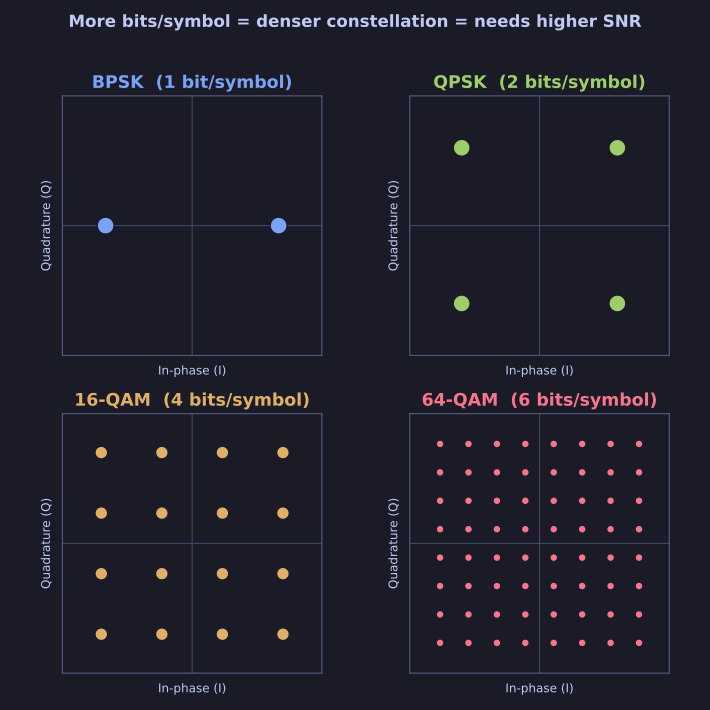
* BPSK to 64-QAM: denser constellations need higher SNR. *
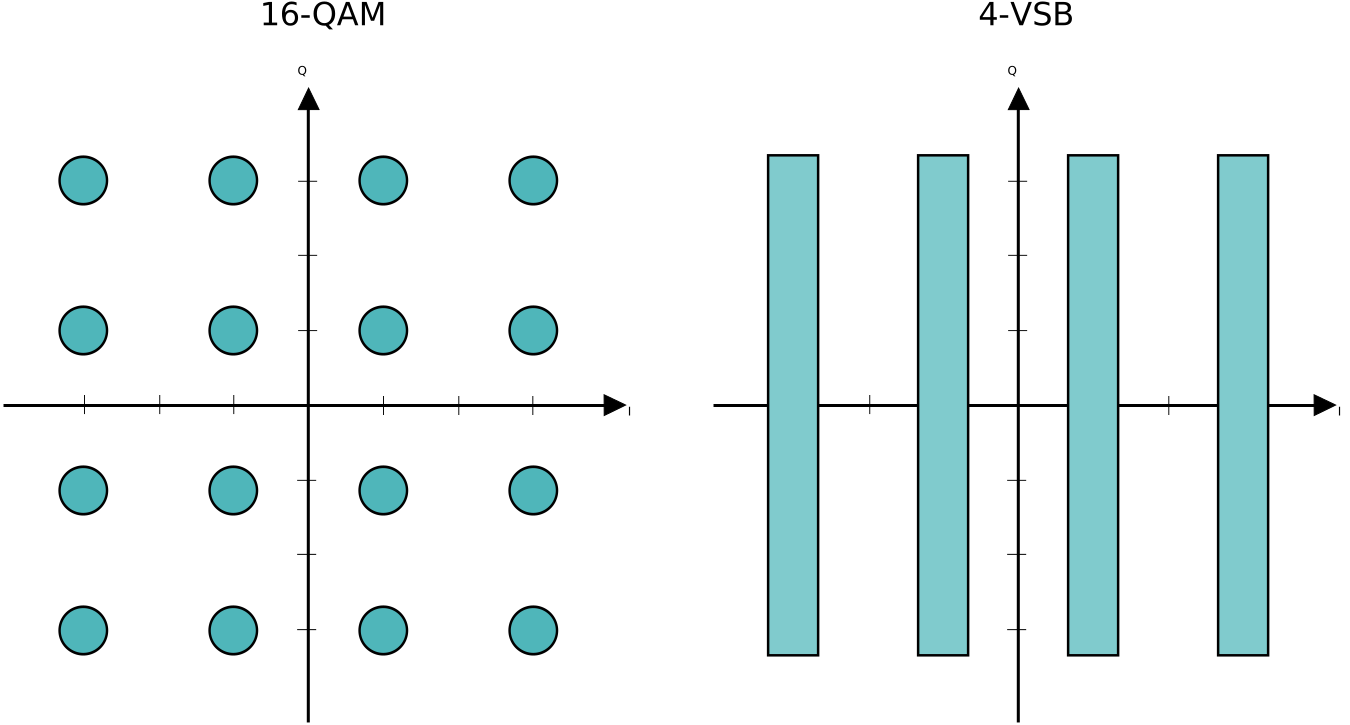
* 16-QAM: denser constellations need higher SNR. — wdwd, CC BY 3.0, via Wikimedia Commons. *
The two key acronyms first:
- SNR — Signal-to-Noise Ratio: how strong the wanted signal is compared to background noise, measured in dB. Higher SNR = cleaner channel.
- BER — Bit Error Rate: the fraction of received bits that are wrong (e.g. a BER of 10⁻³ means 1 bit in 1000 is flipped). Lower BER = more reliable link.
The three rules:
- For a given modulation scheme, higher SNR → lower BER (fewer bit errors)
- At a fixed SNR, a faster modulation (more bits per symbol) has a higher BER — more likely to make errors
- You can dynamically switch modulation based on current conditions — this is adaptive modulation
Example modulation schemes and their performance:
| Modulation | Bits per symbol | Throughput | Required SNR |
|---|---|---|---|
| BPSK | 1 | ~1 Mbps | Low (~5 dB) |
| QAM16 | 4 | ~4 Mbps | Medium (~15 dB) |
| QAM256 | 8 | ~8 Mbps | High (~25 dB) |
(BPSK = Binary Phase-Shift Keying, 1 bit/symbol; QAM = Quadrature Amplitude Modulation, where QAM16/QAM256 pack 4/8 bits per symbol.)
Key insight: There's no "best" modulation — it depends entirely on the current channel conditions. BPSK is slow but works in terrible conditions; QAM256 is fast but needs a clean, strong signal.
Go deeper:
 QAM & Constellation Diagrams explained (AKH) — animates how packing more constellation points squeezes the spacing, making higher-order QAM more error-prone as noise grows.
 What is QAM? (Electronics Notes) — error-margin table quantifying why 16-QAM tolerates far less noise than QPSK.
 Quadrature amplitude modulation (Wikipedia) — constellation diagrams showing why 16-/64-/256-QAM pack more bits per symbol but need higher SNR.