Quiz Entry - updated: 2026.07.30
How does Uplink Inner Loop Power Control work in UMTS?
The NodeB (base station) measures interference every 0.667 ms and sends Power-Up or Power-Down commands to each mobile device, which adjusts its transmit power by 1 dB per command.
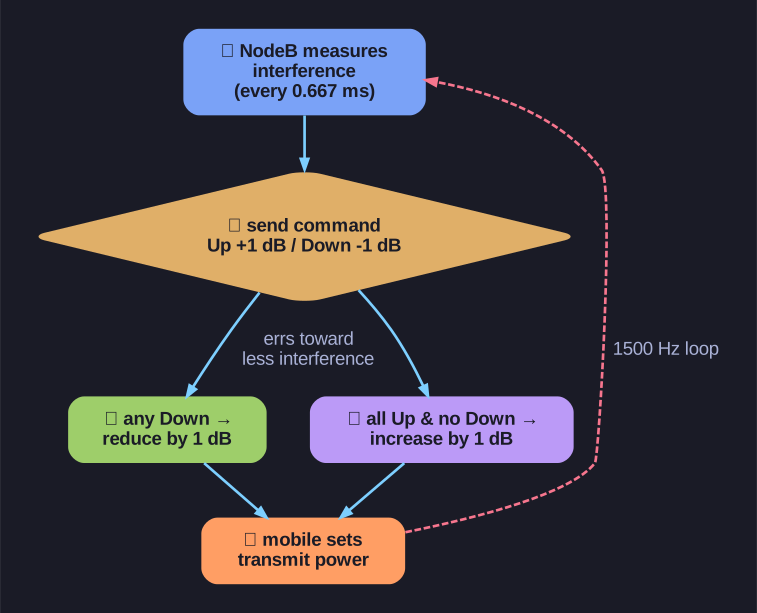
* UMTS inner loop: 1 dB steps at 1500 Hz; down wins over up. *
The mechanism:
- Each NodeB in the active set measures the interference level for each connected mobile device
- Every 0.667 ms (1500 times per second!), it sends a Power Control command: either Power-Up (+1 dB) or Power-Down (-1 dB)
- The mobile station adjusts its transmit power accordingly:
- Reduces by 1 dB when it receives at least one Power-Down command from any NodeB
- Increases by 1 dB only when it receives Power-Up commands from all NodeBs (and no Power-Down)
Why this asymmetry? The rule "reduce on any Power-Down, increase only if ALL say Power-Up" errs on the side of reducing interference. It's better to be slightly too quiet (one user's quality suffers a bit) than too loud (everyone's quality suffers).
The three power control loops in UMTS:
| Loop | Speed | Purpose |
|---|---|---|
| Inner loop | 1500 Hz | Fast compensation for fading and movement |
| Open loop | Initial | Sets initial power based on estimated path loss |
| Outer loop | ~100 Hz | Adjusts the target SNR based on measured BER quality |
Go deeper:
 Power control (Wikipedia) — confirms the 1500-times-per-second WCDMA loop versus GSM's ~2 Hz and why fast control matters.
- Near–far problem (Wikipedia) — why the inner loop equalizes received power so a close phone doesn't drown a far one.