If 1,000 students run the coin-flip protocol and 650 answer "Yes," how do you recover the true number of "Yes" users?
True YES = (Observed YES − expected random YES) ÷ P(true answer) = (650 − 250) ÷ 0.5 = 800 (≈80%).
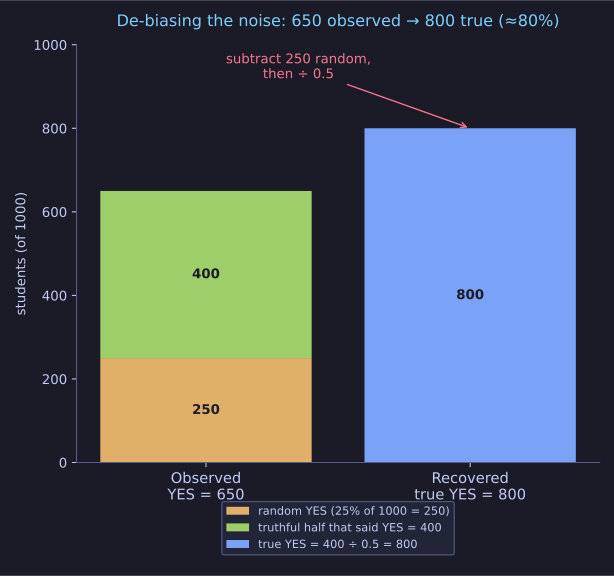
* De-biasing the noise: subtract expected random Yes, divide by 0.5, recover the true count. *
Because you know the noise distribution (50% true, 25% random "Yes", 25% random "No"), you can mathematically subtract it out:
- Of 1,000 students, 250 (25%) are expected to send a random "Yes" regardless of truth.
- Observed "Yes" = 650 → after removing the 250 random ones, 400 "Yes" came from the truthful 50%.
- Scale back up by the 0.5 probability of answering truthfully: 400 ÷ 0.5 = 800.
So ~800 of 1,000 (≈80%) truly used AI tools. Individual privacy is protected, yet the aggregate is accurate. This is the magic of DP: noise that's random per-person but predictable in aggregate.
Tip: The estimate is unbiased because you designed the noise. You can't de-noise an individual record, but you can de-bias the group total.