Quiz Entry - updated: 2026.07.30
What are intuitive analogies for the four multiple access schemes (SDMA, FDMA, TDMA, CDMA)?
SDMA is like people talking in different rooms; FDMA is like dog whistles at unhearable frequencies; TDMA is like taking turns speaking; CDMA is like recognizing a friend's voice in a crowd.
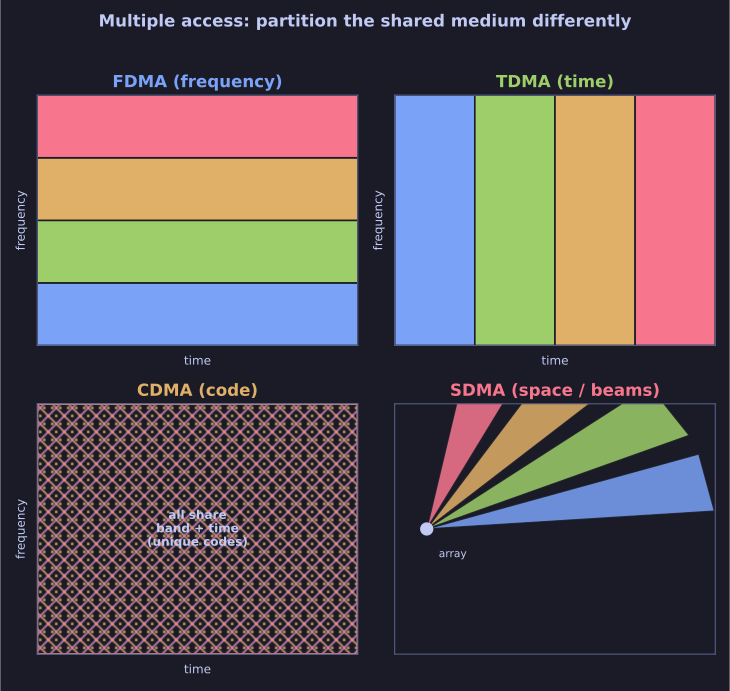
* The four access schemes on the time-frequency grid (plus SDMA beams). *
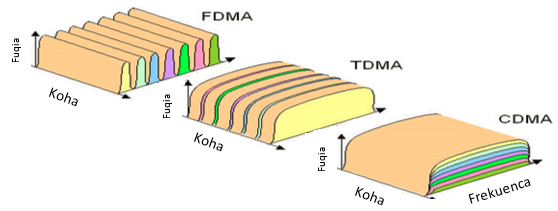
* FDMA, TDMA and CDMA partition the medium differently. — KaltrinaMu, CC BY-SA 4.0, via Wikimedia Commons. *
| Access scheme | Analogy | How separation works |
|---|---|---|
| SDMA (Space) | People talking in different locations far enough apart not to disturb each other | Physical distance/direction |
| FDMA (Frequency) | A dog whistle or bat echolocation — signals at frequencies humans can't hear, so they don't interfere with speech | Different frequency bands |
| TDMA (Time) | A classroom where only one student speaks at a time, or a parliament where each speaker gets a fixed time slot | Taking turns in time |
| CDMA (Code) | A cocktail party where many people speak simultaneously in different languages — you can focus on your language and filter out the rest | Unique codes (like languages) |
Key insight: These aren't mutually exclusive — modern networks combine them. 5G uses OFDMA (a form of FDMA+TDMA) combined with Massive MIMO (SDMA). Each generation chose the combination that best matched the technology and demand of its era.
Go deeper:
 Multiplexing (Wikipedia) — defines the four division dimensions (frequency, time, code, space) that the room/whistle/turn-taking/cocktail-party analogies map onto.