Quiz Entry - updated: 2026.07.30
What are the core principles of CDMA code-multiplex transmission?
CDMA spreads each user's signal across a wide frequency band using unique codes, then separates users at the receiver through correlation — other users' signals appear as background noise.
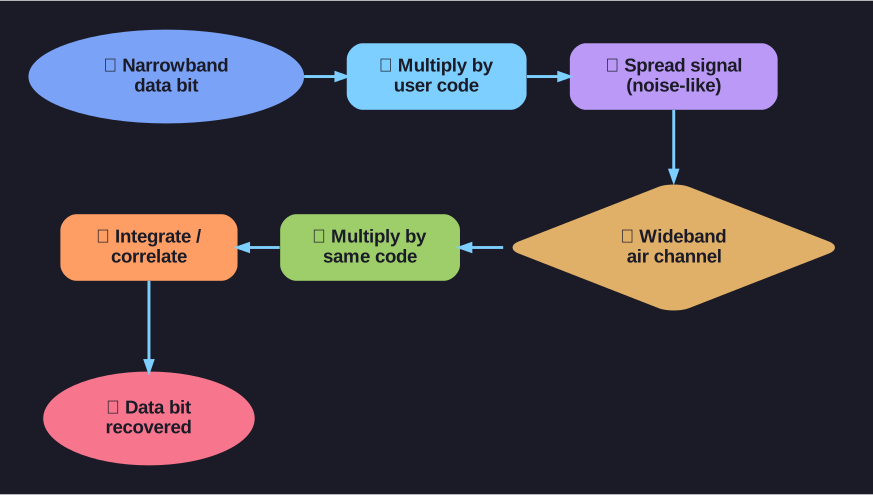
* CDMA spread then de-spread: spread by the code, recover by correlating. *
The three key principles:
1. Spreading:
- Each user's narrowband signal is multiplied by a unique high-rate code, "spreading" it across a much wider frequency band
- The data rate increases (more bits per second), but each bit carries less energy — the signal looks like noise across the wide band
2. Orthogonal separation:
- Users within the same cell use orthogonal codes (channelization codes) — mathematically guaranteed not to interfere
- Users from different cells use pseudo-orthogonal codes (scrambling codes) — nearly non-interfering
3. Correlation filtering:
- The receiver multiplies the received signal by the desired user's code and integrates
- The desired signal "de-spreads" back to its original narrowband form at full power
- All other users' signals remain spread across the wide band → appear as low-level noise
Key insight: CDMA doesn't avoid interference — it manages it. Every additional user in the cell slightly raises the noise floor for everyone else. The system gracefully degrades rather than hitting a hard capacity limit (unlike TDMA where slot 9 simply doesn't exist).
Go deeper:
 Spread spectrum — spreading & de-spreading, visualized (ShareTechnote) — an 8-panel walkthrough of how a narrowband signal is spread to noise-like wideband and recovered by correlation.
 What is CDMA / direct-sequence spread spectrum (Electronics Notes) — the DSSS basis: multiply by a high-rate code to spread, correlate with the same code to de-spread.
- CDMA near-far problem & power control (Electronics Notes) — why "manages, not avoids" forces fast closed-loop power control so a near handset doesn't drown a far one.