Quiz Entry - updated: 2026.07.30
What are the jX (conditional jump) instructions?
jX instructions jump to a label only if the condition codes match — they're how if, loops, and comparisons turn into branches in machine code.
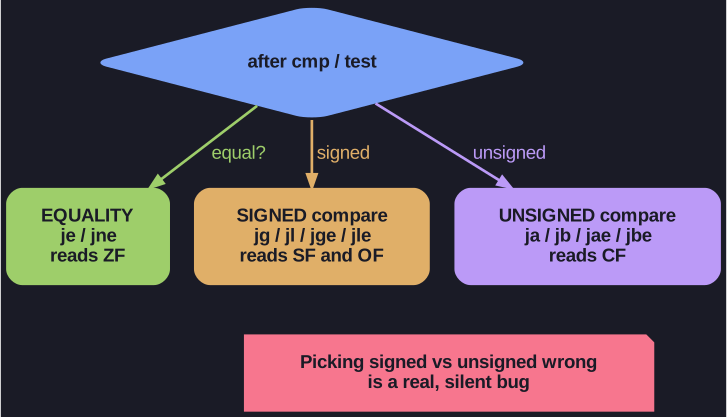
* The same cmp feeds three jump families — equality (ZF), signed (SF/OF), unsigned (CF); picking the wrong one is a real bug. *
A conditional jump reads the flags left by a preceding cmp/test/arithmetic and either jumps or falls through. The suffixes mirror SetX exactly.
| Instruction | Condition | Meaning |
|---|---|---|
jmp |
always | unconditional |
je / jne |
ZF / ~ZF | equal / not equal |
js / jns |
SF / ~SF | negative / non-negative |
jg / jge |
signed | greater / greater-or-equal |
jl / jle |
signed | less / less-or-equal |
ja / jb |
unsigned | above / below |
A typical if (x > y) { … } else { … } compiles to compare-then-branch:
cmpq %rsi, %rdi   # x vs y
jle  .L_else      # if x <= y, skip the "then"
...               # then block
jmp  .L_done
.L_else:
...               # else block
.L_done:
Crucial distinction: signed comparisons use jg/jl (which read SF and OF), unsigned use ja/jb (which read CF). Picking the wrong one is a real bug — the same bytes compare differently depending on signedness.
Go deeper:
 Felix Cloutier — Jcc — shows which flags each jump condition reads.
- Branch (Wikipedia) — the general concept of conditional branching.