What do the HSS and the MME do in the LTE architecture, and how do they work together?
The HSS is the home network's subscriber database; the MME is the control-plane workhorse that authenticates devices (in both directions), manages handover and paging, and sets up the tunnel path for user data.
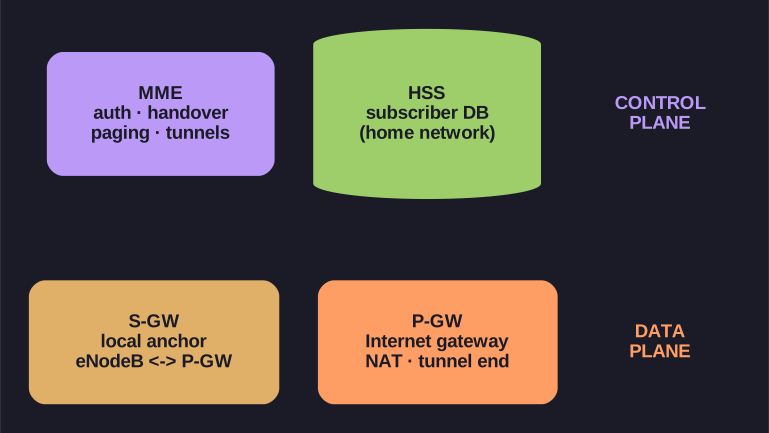
* The four EPC elements, grouped into control and user planes. *
HSS (Home Subscriber Service):
- Stores information about all mobile devices for which this network is the "home network"
- Works together with the MME during device authentication
MME (Mobility Management Entity):
- Device authentication — in both directions (device-to-network AND network-to-device), coordinated with the home network's HSS
- Mobile device management:
- Handover between cells
- Tracking/paging of devices for incoming connections
- Path setup (tunneling) from the mobile device to the P-GW
How they cooperate: When a UE attaches, the eNodeB forwards the request to the MME. The MME fetches authentication vectors from the subscriber's HSS, runs the mutual authentication, and then orchestrates the data-path tunnels through S-GW and P-GW. The HSS knows who you are; the MME proves it and manages where you are.
Tip: Mutual authentication (network proves itself to the device too) is the 3G/4G defense against fake base stations — inherited from UMTS and absent in GSM.
Go deeper:
 Mobility management (Wikipedia) — the tracking-area / paging / location-update machinery the MME runs, and the TMSI use.
- System Architecture Evolution (Wikipedia) — defines the MME as the EPC control node and the HSS as the subscription database.