What is a Message Authentication Code (MAC), and what does it add over a plain hash?
A MAC is a hash computed over the data plus a shared secret key — so only someone who knows the key can produce or verify it.
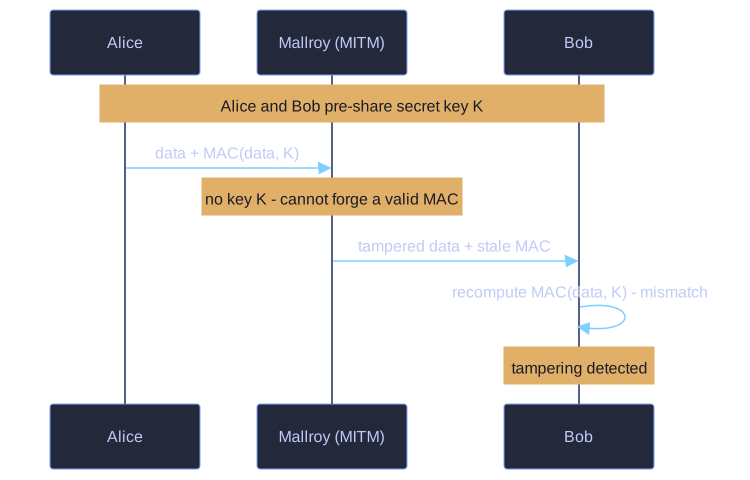
* Mallroy can alter the data but, lacking the shared key, cannot compute a matching MAC — so Bob detects it. *
MAC = hash(data, key). Alice and Bob share a secret key in advance. Alice sends the data + MAC; Bob recomputes the MAC with the same key and compares.
Why Mallroy is stopped: she can alter the data, but without the key she can't compute a valid MAC for her forged version. So a MAC gives:
- Integrity — tampering is detected.
- Authenticity — the message came from someone holding the shared key.
The limitation: because the key is shared, Bob can't prove to a third party that Alice (not himself) created the MAC — both of them could have. That's why a MAC does not give non-repudiation.
Tip: Real MACs are HMAC (e.g. HMAC-SHA256). Think "hash with a password baked in."
Go deeper:
 Message authentication code (Wikipedia) — how a keyed MAC gives integrity + authenticity but not non-repudiation.