What is a multiple-access scheme, and how do FDMA and TDMA each divide the radio medium?
A multiple-access scheme is the rule that lets many subscribers share one radio medium without colliding. FDMA gives each user a separate frequency band; TDMA gives each user a separate time slot.
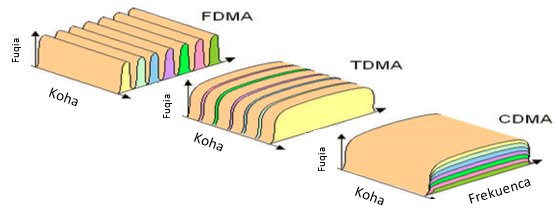
* FDMA, TDMA and CDMA splitting one shared channel. — KaltrinaMu, CC BY-SA 4.0, via Wikimedia Commons. *
When several stations transmit on the same medium at the same time, their signals collide and produce interference. A multiple-access scheme isolates the participants so they can coexist. Every mobile generation defines one for its users (and a scheme can be imposed per user or per cell).
FDMA — Frequency Division Multiple Access:
- Separate, non-overlapping frequency bands
- A user gets exclusive use of one frequency for the entire duration of the connection
- Analogy: each conversation on its own radio station
TDMA — Time Division Multiple Access:
- Separate, non-overlapping time slots within a repeating frame
- A user gets exclusive use of one time slot for the duration of the transmission
- Analogy: everyone shares one frequency but takes strict turns by the clock
Why it matters: FDMA and TDMA both rely on hard, exclusive partitions — once all frequencies (FDMA) or all slots (TDMA) are handed out, no further users fit. This is the conceptual opposite of CDMA, where everyone shares all frequency and all time and is separated only by code.
Go deeper:
 TDMA / FDMA / CDMA / OFDMA / SDMA — multiple access, visualized (YouTube) — animated side-by-side of how each scheme partitions the same resource.
 Murata — Multiplexing & multiple access (1): FDMA / TDMA / CDMA — clean vendor diagrams contrasting frequency-, time-, and code-division on one bandwidth.
 Frequency-division multiple access (Wikipedia) — the frequency-band partition and its guard-band cost.
- Time-division multiple access (Wikipedia) — the time-slot/frame model used in GSM and other 2G systems.