What is adaptive modulation, and why is it essential for mobile networks?
Adaptive modulation dynamically selects the modulation scheme based on current channel conditions — using aggressive modulation when signal is strong and falling back to robust modulation when it's weak.
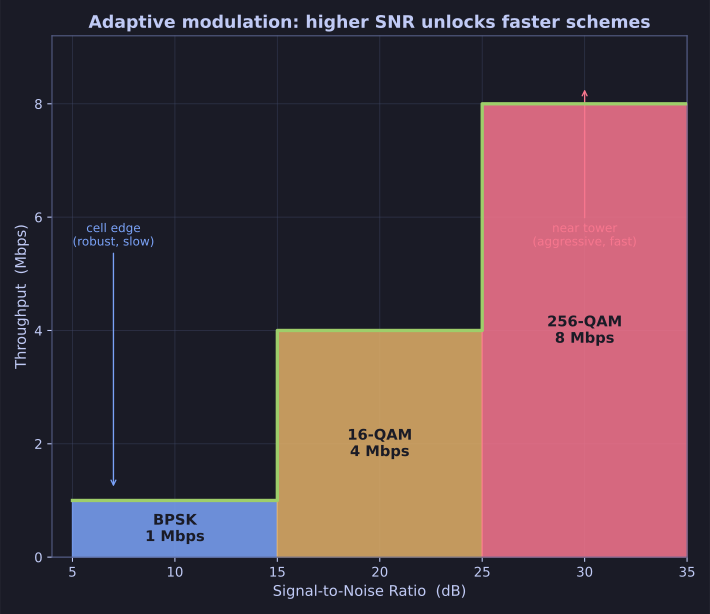
* Adaptive modulation picks the fastest scheme the SNR supports. *
Why it's needed:
- Transmission conditions change constantly due to mobility (user moves closer/farther from tower) and environment (weather, obstacles, interference)
- A fixed modulation would either waste capacity (too conservative) or cause too many errors (too aggressive)
How it works in practice:
- Close to the base station (strong signal, high SNR) → use 64-QAM or higher → maximum throughput
- At the cell edge (weak signal, low SNR) → fall back to QPSK or BPSK → slower but reliable
- The phone and base station continuously measure signal quality and negotiate the best scheme
Visual analogy: Think of concentric rings around a cell tower — the inner ring uses fast modulation (QAM256), middle rings use moderate (16APSK, 8PSK), and the outer ring uses the most robust (QPSK, BPSK). Bad weather pushes everything one ring inward.
Used in: WiFi (802.11), 4G LTE, and 5G NR all use adaptive modulation and coding (AMC). It's one of the key reasons modern networks are so much faster than GSM — they adapt in real-time rather than using one fixed scheme.
Go deeper:
 Link adaptation (Wikipedia) — how adaptive modulation and coding (and power control) match the scheme to live channel conditions.