What is an Instruction Set Architecture (ISA)?
The ISA is the visible interface between hardware and software — the "contract" defining everything a programmer needs to know to reason about the machine, while hiding how it is built.
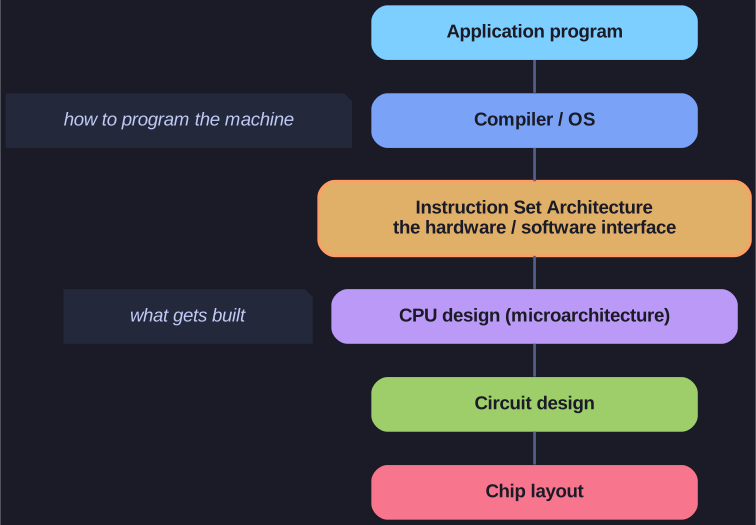
* The ISA is the contract that splits the stack: how you program the machine above, what gets built in hardware below. *
A processor is enormously complex inside, but software shouldn't have to care about transistors and pipelines. The ISA draws a clean line: above it, compilers and programmers see a stable set of instructions, registers, and rules; below it, hardware designers are free to implement those however they like. As Amdahl, Blaauw and Brooks put it in 1964, the ISA is "the conceptual structure and functional behavior as seen by the programmer, as distinct from the data flow, logical design, and physical implementation."
What the ISA specifies:
- The instructions available (what operations exist)
- Data types and their sizes
- The registers (how many, how wide, their roles)
- How memory is addressed (byte ordering, addressing modes)
- The execution model (interrupts, exceptions, privilege)
Why it matters: because the contract is stable, the same binary runs on a simple in-order chip and a complex out-of-order superscalar one. The ISA "tells us what the processor will do, but not how it does it."
Analogy: an ISA is like a restaurant menu — you order dishes (instructions) without needing to know how the kitchen (the microarchitecture) prepares them.
Go deeper:
 Instruction set architecture (Wikipedia) — the canonical reference on the ISA as the hardware/software contract.