Quiz Entry - updated: 2026.07.30
What is FDMA/TDMA combined access, and what is frequency hopping?
FDMA/TDMA combines frequency and time division — each user gets a specific time slot on a specific frequency. Frequency hopping adds robustness by switching frequencies between time slots.
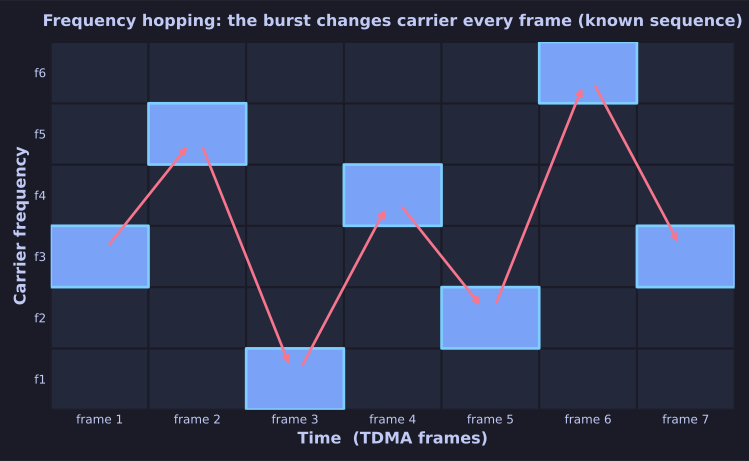
* Frequency hopping: the burst changes carrier every frame along a sequence both ends know. *
FDMA/TDMA (used in GSM):
- First, spectrum is divided into frequency channels (FDMA) — GSM-900 has 124 channels of 200 kHz each
- Each frequency channel is divided into 8 time slots (TDMA frame)
- A user gets one time slot on one frequency → they transmit in short bursts
- Between bursts, other users use the same frequency in their time slots
Frequency hopping:
- Instead of staying on one frequency, the device switches frequency after each TDMA frame according to a predefined hopping sequence
- The hopping pattern is known to both the device and the base station
Why frequency hop?
- Combats frequency-selective fading — if one frequency has a deep fade, the next hop will be on a different frequency that's likely fine
- Reduces interference — an interfering signal on one frequency only affects one hop, not the entire call
- Averages out channel quality across frequencies
- Technically more complex — requires fast frequency synthesizers
Tip: Bluetooth also uses frequency hopping (1600 hops/second across 79 channels) — it was actually inspired by a WWII patent for torpedo guidance!
Go deeper:
 Frequency-hopping spread spectrum (Wikipedia) — how hopping fights narrowband interference and fading, plus its use in GSM and Bluetooth.