What is MIMO, and what three benefits does multi-antenna technology bring to LTE?
MIMO (Multiple Input Multiple Output) coordinates multiple transmitters and receivers to achieve better spectral efficiency, higher data rates, and more robustness against interference.
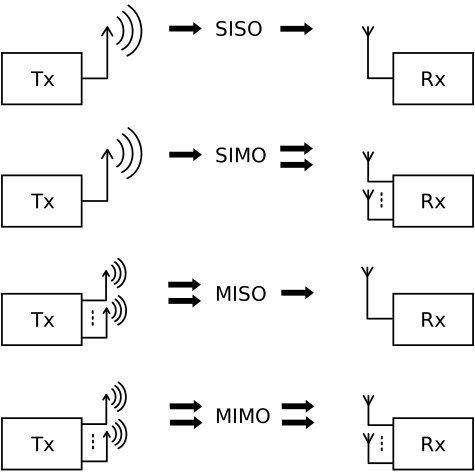
* SISO, SIMO, MISO and MIMO antenna setups. — Benbaum, CC BY-SA 3.0, via Wikimedia Commons. *
The three benefits:
- Better use of radio resources (spectral efficiency — more bits per Hz)
- High data rates — parallel spatial streams multiply throughput
- Robustness against interference (Störunanfälligkeit) — the same data arrives over several antenna paths, so a path that fades or gets jammed no longer kills the link; the receiver reconstructs the signal from the survivors
The MIMO technique family:
| Technique | Idea |
|---|---|
| Space-Time Coding | Send redundant, cleverly coded copies over multiple antennas → robustness |
| Spatial Multiplexing | Send different data streams over each antenna → multiplied data rate |
| Network MIMO | Multiple base stations cooperate as one giant antenna array |
The mind-shifting insight: Interference can contain useful information, and with proper processing it can sometimes be exploited. Classical radio treats every foreign signal as noise to be avoided. MIMO signal processing inverts this: if you know the structure of the interfering signals, you can mathematically separate them — turning interference from an enemy into a resource.
Tip: Remember the trade-off pair: space-time coding spends antennas on reliability, spatial multiplexing spends them on speed. Real systems switch between the two based on channel quality — the spatial equivalent of adaptive modulation.
Go deeper:
 What is Beamforming (Massive MIMO)? (Mpirical) — a clean animated walk-through of multi-antenna transmission that visualises how spatial streams and beamforming differ.
 MIMO spatial multiplexing (Electronics Notes) — the depth this card's "space-time coding vs spatial multiplexing" split needs: the t1…tn stream matrix, the rule that receive antennas ≥ transmit antennas, and the Shannon-capacity gain.
- MIMO (Wikipedia) — the multi-antenna principle and the diversity-vs-multiplexing trade-off this card hinges on; kept for its diagrams (carousel).