What is Multi-BS Collaborative MIMO (Network MIMO)?
In collaborative MIMO, signals are precoded and received/processed by all participating base stations together, increasing performance especially at the cell edge — but it requires a coordination entity.
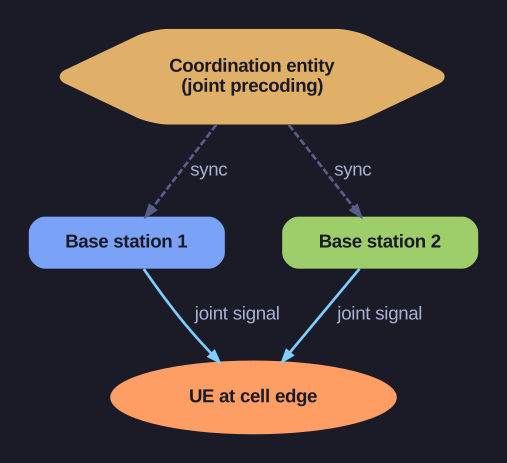
* A coordination entity syncs two base stations so both send a joint signal to the cell-edge UE — the neighbour that used to interfere now serves it. *
How it works:
- Signals are precoded (mathematically prepared so they combine constructively at the receiver)
- All cooperating base stations receive and process the signals jointly — the cell borders effectively disappear for the signal processing
- A coordination entity is required to orchestrate the cooperation
The key benefit — cell edge performance:
The cell edge is the worst place in any mobile network: the signal from your tower is weak, and the neighboring tower's signal is strong interference. Collaborative MIMO flips this: the "interfering" neighbor becomes a second serving antenna. The worst-case location becomes a well-served one.
Connection to MIMO: this is "interference contains useful information" applied at network scale — the neighboring base station's signal stops being noise and starts being signal.
Modern names: This concept appears in 3GPP standards as CoMP (Coordinated Multi-Point) and evolves into Cell-Free Massive MIMO in 5G/6G research.
Go deeper:
 Cooperative MIMO (Wikipedia) — base stations sharing CSI to jointly transmit and lift cell-edge throughput (a.k.a. network/distributed MIMO, CoMP).
- MIMO (Wikipedia) — places cooperative/multi-user MIMO inside the broader multi-antenna family.