What is mutual authentication, and how does it combine the two one-way flows?
Both parties authenticate each other in one interleaved exchange — each sends a challenge and each verifies the other's response.
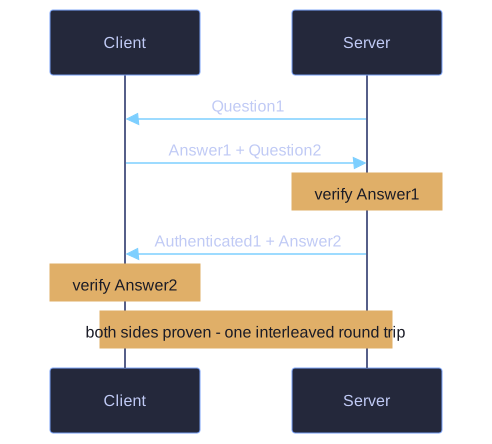
* The second challenge piggybacks on the first response, so both sides prove themselves in one round trip. *
It merges client-side and server-side authentication into a single round-trip-efficient flow:
- Server → Question1
- Client → Answer1 + Question2 (answers the server and challenges it back)
- Server verifies, → Authenticated1 + Answer2
- Client verifies → done.
Now both sides have proven their identity to the other. Neither is talking to an impostor.
Why it matters: one-way auth leaves a gap. If only the client authenticates, it might be handing credentials to a fake server (phishing). Mutual auth (e.g. mTLS) closes that — the client also confirms the server is genuine.
Tip: Mutual auth is standard in high-security and machine-to-machine settings (mTLS, smartcards). The clever part is piggybacking the second challenge onto the first response to save a round trip.
Go deeper:
 Mutual authentication (Wikipedia) — reciprocal authentication and how mTLS closes the fake-server gap.