Quiz Entry - updated: 2026.07.30
What is power control in mobile networks, and what problem does it solve?
Power control dynamically adjusts each device's transmit power so that all signals arrive at the base station with roughly equal strength — solving the near-far problem.
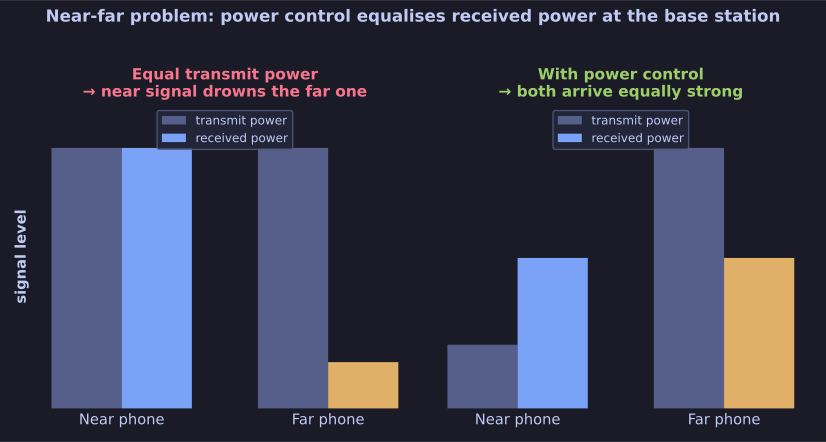
* Near-far problem: power control raises the far phone's power and lowers the near one so both arrive equally strong. *
The problem (near-far problem):
- A phone close to the base station has a strong signal; a phone far away has a weak signal
- Without power control, the nearby phone's signal would drown out the distant phone's signal at the base station
- This is catastrophic for CDMA, where all users share the same frequency — a strong signal raises the noise floor for everyone
The solution:
- The network instructs each device to transmit at just the right power level
- Nearby devices → reduce power (save battery, reduce interference)
- Distant devices → increase power (maintain signal quality)
- Goal: all signals arrive at the base station at roughly equal strength
A fast feedback loop is required to compensate for constantly changing path loss (due to movement, fading, obstacles). The system must react in milliseconds.
Bonus benefits:
- Battery savings — devices don't waste energy transmitting at maximum power when they're close to a tower
- Reduced interference — lower transmit power means less interference for neighboring cells
- Increased network capacity — less interference = more users can be served simultaneously
Go deeper:
 CDMA near-far problem (Electronics Notes) — quantifies how steeply signals decay with distance (≈1/d³·⁴) and why power control must equalise received strength.
- Near–far problem (Wikipedia) — why a close transmitter drowns out a distant one and how power control equalises received power.