Quiz Entry - updated: 2026.07.30
What is SDMA (Space Division Multiple Access) and how does it work?
SDMA uses directional antennas to serve different users in different spatial directions simultaneously — the separating dimension is physical space.
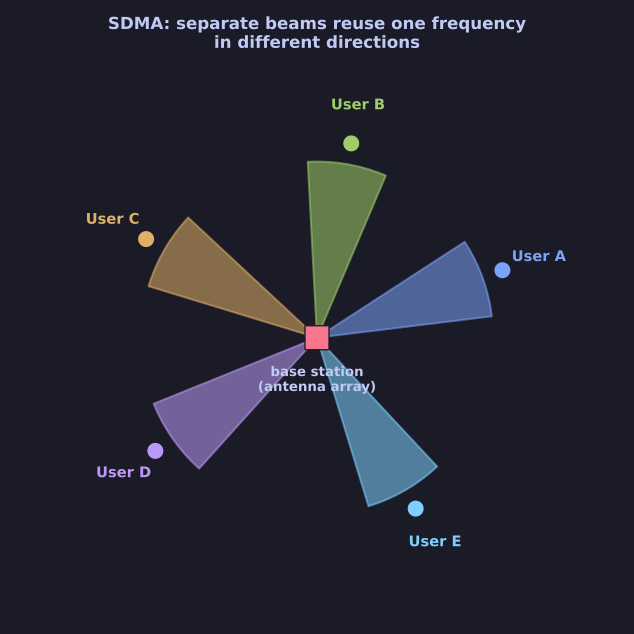
* SDMA: separate beams reuse the same frequency toward users in different directions. *
How it works:
- Instead of an omnidirectional antenna (broadcasts in all directions), use directional antennas or adaptive antenna arrays
- Different antennas (or beams) point in different directions
- Users in different directions can be served on the same frequency at the same time without interfering
Key characteristics:
- The "medium" being divided is physical space — specifically, the direction from the base station
- Steering of smart antennas (adaptive antenna arrays) is done electronically, not mechanically — no physically moving parts
- Can be combined with FDMA/TDMA or CDMA for even more capacity
Modern relevance — Massive MIMO and beamforming:
SDMA is the precursor to Massive MIMO in 5G, where base stations have 64, 128, or even more antenna elements that can form dozens of independent beams simultaneously. Each beam essentially creates a separate spatial channel. This is one of the key technologies that makes 5G so much faster than previous generations.
Go deeper:
 Massive MIMO & Beamforming made simple (Our Technology Planet) — visualises how a many-element array steers independent beams to separate users in space — SDMA at 5G scale.
 MIMO (Wikipedia) — multiple antennas, spatial multiplexing and beamforming, the technology SDMA grows into in 4G/5G.