What is the "data dilemma," and how does differential privacy resolve it?
Companies need data to improve products while users need privacy — differential privacy satisfies both by adding calibrated noise that hides individuals but preserves group patterns.
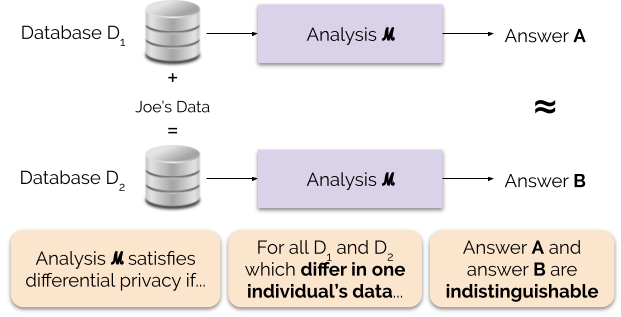
* Including or excluding one person barely changes the output. — Near, Darais & Boeckl, Public domain, via Wikimedia Commons. *
The tension: organizations need real usage data (measuring beats guessing), but individuals need privacy because personal information can be sensitive and harmful if exposed. These look contradictory.
Differential privacy (DP) dissolves the dilemma. It's a mathematical technique that lets you collect meaningful insights about groups of users while protecting the privacy of any individual. The trick: add carefully calibrated statistical noise to the data (or query results) in a way that preserves overall patterns but makes it impossible to identify a specific person or their contribution.
Tip: DP shifts the question from "is this dataset anonymous?" to "does adding/removing one person change the output?" If not, that person is protected.
Go deeper:
 Differential privacy (Wikipedia) — the "does adding/removing one person change the output?" framing with the epsilon budget.
- The Algorithmic Foundations of Differential Privacy (Dwork & Roth, PDF) — the definitive monograph behind the promise.